

公開日:
Lean Improvement
What Is Cellular Manufacturing? Cell Types, Setup, and an Assembly Example

Cell production method is a production system where one or few workers take on a consolidated range of processes. Parts and equipment are placed close together, linking assembly to inspection. Arranging equipment in a U-shape is not the objective itself.
While reducing variety switching and task handoffs, the expanded scope of responsibility necessitates education and workload verification. This article explains variety, suitable conditions, and implementation procedures using the automobile parts unit assembly as an example.
- What is cell production method? Its relationship with line production
- Common manufacturing cell types
- Advantages and disadvantages of cell production
- When cellular manufacturing works well and what to watch for
- Unit assembly for introducing cell production
- 1. Determine target part numbers and required quantities
- 2. Separate manual, automatic, and walking time
- 3. Reconfigure layout and scope of responsibility
- 4. Educate first, then test under the same conditions
- Information to retain when comparing work composition proposals
- Common questions.
- Will it become cell production if arranged in a U-shape?
- Can it be introduced until multi-skilling is complete?
- Summary: Cell production is designed as a set of composition and education.
- Ollo Factory, a manufacturing-specialized task analysis AI that supports task composition and education.
- Standardize the assigned task range with Video Manual AI.
- Solidify the video manual created with Comparison Analysis AI.
- Visualize manual work, walking, and waiting with Operation Analysis AI.
- Extract candidate measures with Improvement Suggestion AI.
- Visualize the workload burden of workers with Work Posture Assessment AI.
- Watch Ollo Factory’s Work Analysis in Action
What is cell production method? Its relationship with line production
In line production, processes are divided among multiple workers or equipment, with products flowing sequentially. In cell production, tasks required for small, consolidated units are gathered, with the operator taking on multiple processes.
Even when multiple people are in the cell, combining automated equipment operation is possible. The approach does not have to be limited to "one person performing all tasks manually." Consider process consolidation and task allocation.
For unit assembly, a proposal is to consolidate component set, fastening, extraction, and completion confirmation into one cell. However, in cases of large shared equipment or special inspection, it may be necessary to leave the cell outside.
Please refer to the following for cell production and line production.Cellular vs. Line Production: How to Choose Based on Variety, Volume, and TrainingDifferences between cell production method and line production method | Selection based on variety, quantity, and education
Common manufacturing cell types
Method | Task allocation method | Design confirmation points |
|---|---|---|
1-person complete type | One person handles a sequence of processes | Skill range, burden, and handling of vacancies required |
Division type | Divide the cell into a small number of people to assign tasks | Work time bias, handover, and ease of support |
Circulating type | The operator rotates through multiple processes and equipment sequentially | Walking, waiting for equipment completion, and entry conditions |
Inline type | Connect multiple processes and cells in a straight line, dividing tasks among a small number of people | Process time bias between processes, handover and work-in-progress between cells and the impact of a stop at one point on the whole |
Inline type is an intermediate form between line production and cell production. It consolidates the scope of responsibility like a cell while linking processes to flow, thus requiring balance confirmation between processes as in line production.
Names and classifications vary depending on the field. It is important to determine the scope of responsibility that can be produced with the required quantity while maintaining quality and safety, rather than selecting a type first.
Advantages and disadvantages of cell production
Regarding advantages, the following three points are mentioned:
Reduced implementation cost
Reduced burden of variety switching and task handoffs
Easier development of multi-skilled workers
Regarding multi-skilled workers,On the other hand, regarding disadvantages, the following two points are mentioned:Please refer to the following for multi-skilled worker development methods | Determining the training order from skill maps
Long education time
Complex labor management becomes more difficult
Conditions and precautions for cell production
When cellular manufacturing works well and what to watch for
With species change, a process that consolidates multiple tasks to reduce delivery and work-in-process inventory is considered. However, multi-variety, small-quantity production does not necessarily benefit from cell production.
Even when consolidating tasks, whether equipment capacity and inspection conditions become production constraints.
For expanding scope, can education be provided and can independent operation be confirmed?
Can component replenishment, handling of heavy items, walking, and response to staff shortages continue without strain?
Relying solely on worker skill leads to varying time and quality depending on the operator. Design a system that aligns task sequence and decision criteria, along with skill acquisition requirements.
Unit assembly for introducing cell production
1. Determine target part numbers and required quantities
First, determine which product group to produce in cells. Confirm part number quantities, switching frequency, and component commonality, then narrow the scope to a single product group (cell) for testing.
When calculating takt time from required quantities, use the same period’s actual productive time and required quantity. Standardize handling of breaks and planned stops, avoiding the assumption that a single fast task alone determines capability.
2. Separate manual, automatic, and walking time
Record time and conditions for each task element by filming current operations. Here, tasks and times are organized as follows. Numerical values are illustrative examples.
Task | Manual work | Automatic time | Walking | Sequence conditions |
|---|---|---|---|---|
Housing set to fixture | 8 seconds | 0 seconds | 0 seconds | Before automatic operation |
Automatic tightening | 2-second start operation | 20 seconds | 0 seconds | Confirm if other tasks can be performed during automatic time |
Extraction and inspection | 10 seconds | 0 seconds | 2 seconds | After automatic operation completion |
Summing all these times does not yield the actual cycle time. Handwork performed while the equipment is running overlaps. Establish a common time axis for start and end, including waiting time and walking.
3. Reconfigure layout and scope of responsibility
Arrange components, tools, and inspection equipment in order of use. Reducing reach distance may narrow walkways or restrict escape routes, or enter hazardous equipment zones—which is counterproductive.
If a proposal exists for preparing the next component during automatic tightening, first confirm monitoring requirements and access conditions. Aim not to constantly move the worker, but to evaluate the time required for quality checks and physical strain.
When assessing physical strain, OWAS method posture evaluation proves useful. For OWAS method,What is OWAS method? Task posture evaluation procedure and recording examplesplease refer to it.
4. Educate first, then test under the same conditions
Turn task sequence, cautions, and completion confirmation into a procedure document. Distinguish between having received explanation and being able to execute alone.
During testing, record part numbers, personnel, proficiency, equipment conditions, and measure multiple cycles. In addition to production volume, verify defective parts, rework, work-in-process inventory, walking, and time required for education. Even if quantities increase, re-evaluate the composition if burden worsens or quality declines.
For time analysis to consider work composition and creating teaching materials for defined procedures, AI using video can be utilized.
Information to retain when comparing work composition proposals
When changing the composition, record which task was transferred to whom, using the same part number, number of people, and measurement conditions before and after the change. A shorter total time alone does not confirm that the composition is established.
The assigned task elements, and the measured values for manual work, automated time, and walking.
The order of tasks, conditions for parallel tasks, quality, safety, and skill constraints.
The production quantity after trial, rework, semi-finished goods, workload, and educational challenges.
Please refer to.How to create a pile table | How to find line balance and bottlenecks..
Common questions.
Will it become cell production if arranged in a U-shape?
Shape alone cannot determine it. If there are residual conditions such as retrieving parts, waiting between processes, or delayed inspection, the effect of changing the arrangement is limited. Review the process ownership and flow together.
Can it be introduced until multi-skilling is complete?
Not all personnel need to be able to perform all processes. Narrow the scope, and develop skills from the assigned tasks and the skills required for substitute personnel. It is important not to expand the scope without mastering the task.
Summary: Cell production is designed as a set of composition and education.
Cell production is a method where one person or a small group handles a consolidated process.
Separate manual work, automated time, and walking, and confirm overlapping time and constraints.
Confirm production quantity, quality, workload, education, and operation during shortages through trial, not just production quantity.
The consideration of composition requires detailed organization of current tasks. Using Video Analysis AI can streamline the aggregation of time and the drafting of procedure manuals, allowing time for considering arrangement and task scope.
Ollo Factory, a manufacturing-specialized task analysis AI that supports task composition and education.
Ollo Factory analyzes task videos with AI and supports education and improvement.Video Manual AI.、Comparison Analysis AI.、Operation Analysis AI.、Improvement Suggestion AI.、Work Posture Assessment AI.5 functions.
Standardize the assigned task range with Video Manual AI.
Video Manual AI.Upload the task video to split the procedure and automatically generate task names and descriptions. You can reference existing procedure manuals as reference materials or output in your company's Excel form. It is useful for standardizing tasks where the assigned range has expanded in cell production and for education.
 Demo screen of the Ollo Factory official website.
Solidify the video manual created with Comparison Analysis AI.
Comparison Analysis AI.Compare two task videos, such as a model and a newcomer, to check the time and movement of the task elements. Confirm the differing sections in the video and consider the points for guidance and practice. In addition to solidifying the created manual, you can compare multiple cycles to narrow down the candidates for areas where mistakes are likely to occur.
 Demo screen of the Ollo Factory official website.
Visualize manual work, walking, and waiting with Operation Analysis AI.
Production Analysis AIClassify work videos into segments and aggregate/visualize time for each segment. Set classification criteria for work, movement, waiting time, etc., tailored to the site. Useful for optimizing step 2 of implementation: "Separate manual work, automated equipment time, and walking."
 Ollo Factory official website demo screen.
Extract candidate measures with Improvement Suggestion AI.
Improvement Suggestion AIExtract candidate problems from work videos and present improvement proposals. Return to specific video scenes to confirm, then consider site-appropriate improvements.
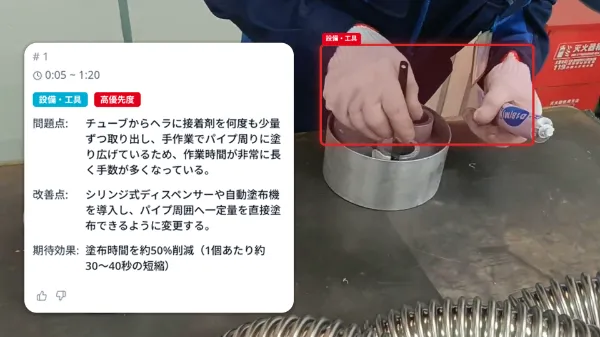 Ollo Factory official website demo screen.
Visualize the workload burden of workers with Work Posture Assessment AI.
Work Posture Assessment AIFrom full-body work videos, analyze the skeleton and evaluate posture using OWAS method and REBA method. Check evaluations per work element and time series burden, and re-evaluate results by changing load conditions. Helps identify work strain and consider burden reduction and improvement.
 Ollo Factory official website demo screen.
Ollo Factory can support the introduction of cell production from creating video manuals to comparing and improving work.
If you want to introduce cell production, please refer to Ollo Factory materials.
Request Ollo Factory materials.
Watch Ollo Factory’s Work Analysis in Action
この記事の執筆者
株式会社Ollo
事業開発部リーダー マーケティング担当 Yoshida
製造業特化型の作業分析AI「Ollo Factory」を開発・提供する株式会社Ollo(東京大学 松尾研究室発のAIスタートアップ)で、事業開発とマーケティングを担当。
大学時代は工学部で設計開発を学び、新卒で大手自動車メーカーに入社。新型EVの開発グループで、設計から工場での生産まで幅広くプロジェクトに携わり、研修の一環として、実際に自動車製造工場でのライン作業も経験。その後、製造業領域のスタートアップで営業・マーケティングに従事。
現在は、製造現場でのAI活用を促進し、よりワクワクする働き方を実現できるよう、「Ollo Factory」の販売・マーケティングに取り組んでいる。
一覧に戻る
関連記事
Ollo Factoryについて、さらに詳しく。

まずは資料請求
・ 導入事例と効果
・ 主な機能
・ 活用の流れ
