

Published:
Lean Improvement
What Is Just-in-Time Production?

When we reduced our parts inventory, we started experiencing more shortages and assembly had to stop. When implementing just-in-time production, it's necessary to create conditions that ensure smooth use and replenishment before cutting inventory.
This article explains the meaning of Just-In-Time (JIT) and the concepts of "flow modeling," "cycle time," and "pull collection" commonly used in the workplace. Using the assembly of automotive parts as an example, we will organize the points to check before implementation.
- What is Just-In-Time? It's about aligning the necessary elements, timing, and quantity.
- Applying the three principles of Just-In-Time to the workplace
- Flow management: Connecting processes without accumulating data between them.
- Cycle time: Determining the pace of production based on the required quantity.
- Pull from the next process: To replenish the used product.
- Differences from the Kanban system
- Things to check before trying JIT in unit assembly
- Fluctuations in demand and replenishment time
- Capabilities and quality of upstream and downstream processes
- Rules for when an anomaly occurs
- Test it in one step to check the flow and the load.
- The rules for collection and replenishment must be standardized among all parties involved.
- Summary: JIT (Just-In-Time) creates the conditions for inventory to flow before reducing it.
- Ollo Factory is a manufacturing-specific AI for analyzing cycle variability and waiting times.
- Use AI to break down and standardize work procedures in video manuals.
- Visualize waste with AI-powered operational analysis.
- Watch Ollo Factory’s Work Analysis in Action
What is Just-In-Time? It's about aligning the necessary elements, timing, and quantity.
Just-in-Time (JIT) is a concept that involves producing and delivering only what is needed, when it is needed, and in the required quantity. It is known as one of the two pillars of the Toyota Production System.
Regarding the Toyota Production System, please also check out " What is the Toyota Production System? Its two main pillars and how to implement on-site improvements ."
The goal is not only to reduce inventory, but also to reduce the stagnation of goods and information, and to create a flow that ensures necessary products are delivered with good quality. By matching the amount actually used in the downstream process with the replenishment in the upstream process, overproduction is prevented.
This doesn't mean "zero inventory." The required quantity varies depending on demand, replenishment time, and fluctuations in quality and supply. We improve the process while confirming the conditions that can be maintained on-site.
Applying the three principles of Just-In-Time to the workplace
In practical explanations, the concepts of streamlining, cycle time, and pull are often organized into three principles. Instead of implementing each of these individually, the interconnectedness of these principles is considered.
Flow management: Connecting processes without accumulating data between them.
This reduces the long waiting times for products between processing, assembly, and inspection. In unit assembly, we check whether methods such as inputting large quantities of parts at once or setting them aside before inspection are causing delays or bottlenecks.
Even when considering a single-piece flow system, we must consider the equipment's capacity, setup, quality control, and transportation conditions. Simply reducing the number of storage locations may lead to supply shortages or unreasonable transportation requirements.
Cycle time: Determining the pace of production based on the required quantity.
Cycle time represents the pace at which production must proceed in relation to the required quantity. Generally, it is calculated by dividing the available operating time for a given period by the required production quantity for that period.
For example, if the available operating time is 24,000 seconds and the required quantity is 400 units, the cycle time would be 60 seconds per unit. This is not a number to instruct workers to "always complete the work in 60 seconds." It is used as a standard to check the actual cycle, quality, equipment downtime, and load imbalances, and to adjust the required capacity.
Using a standard work combination sheet makes it easier to check how human work and walking fit into the cycle time. For instructions on how to fill it out and examples, please refer to "[Free Template] How to Fill Out a Standard Work Combination Sheet | Examples and How to Read the Time Axis" . You can download the free template from the article.
Pull from the next process: To replenish the used product.
This system involves the upstream process receiving the parts needed by the downstream process and replenishing them. It clearly defines what parts to replenish, in what container units, and to where.
One way to convey information is to use Kanban. This involves not only creating cards, but also assigning responsibilities and timings for collection, transportation, replenishment, and return.
Differences from the Kanban system
perspective | Just-in-time | Kanban system |
|---|---|---|
Positioning | The idea of matching what is needed, the time, and the quantity. | A system for conveying information about pickup and replenishment. |
subject | Includes process flow, capacity, operations, and supply. | Responding to parts, container, and replenishment instructions. |
Points to note | Don't just cut down on inventory first. | Do not neglect the number of cards or the rules for collecting them. |
Kanban is one method for implementing JIT (Just-In-Time), and the two are not synonymous. Smaller production batches, improved setup, and stable quality are also necessary to streamline the process.
Things to check before trying JIT in unit assembly
Fluctuations in demand and replenishment time
We will examine not only average usage but also fluctuations due to product number changes and time of day. Replenishment time will include not only production time but also card collection, transportation, waiting, and returns.
Even if working hours are stable, shortages will occur if replenishment deliveries are delayed. Determine the safety factor and the required number of containers by considering fluctuations and risks, and verify them through trials.
Capabilities and quality of upstream and downstream processes
We verify whether the preceding process can consistently replenish the required amount for the subsequent process. If there are many defects or rework issues, there will be a difference between the amount used and the number of good products supplied.
The explanation of lean manufacturing methods provided by J-Net21 of the Organization for Small & Medium Enterprises and Regional Innovation, Japan, is also a useful reference when considering production methods to suit the conditions of the workplace. It's important to check not only the efficiency of a single process, but also the flow before and after it.
Rules for when an anomaly occurs
This section determines when to contact and make decisions regarding delays in replenishment, loss of Kanban cards, and defects. Allowing an unlimited supply of emergency items to be inserted can disrupt normal replenishment and potentially lead to further shortages.
Who will be responsible for detecting the anomaly, and who will be contacted?
Who decides whether to replenish or increase production in a manner different from the norm?
How will we handle containers, cards, and inventory after the recovery?
Test it in one step to check the flow and the load.
Determine the target product numbers and supply range, and record the current work-in-progress quantity, stockouts, shipments, and work interruptions. If you change the replenishment rules, compare them with the same target items and conditions.
We don't consider it a success simply because inventory has decreased; we also check whether the required quantity can be supplied and whether the burden on workers (walking) or logistics has increased. If there is significant variation in setup or work time, we improve the cause before reviewing the number of containers.
AI analysis of videos can also be used to investigate variations in work processes and waiting times, and to stabilize those processes.
The rules for collection and replenishment must be standardized among all parties involved.
Before testing in a single process, it's crucial to confirm that the replenishment rules are the same for everyone involved: those using the parts, those transporting them, and those manufacturing them. It's important to decide not only the part numbers and container labels, but also who will act, when, and what signals will guide their actions.
Target product numbers, usage processes, and locations and personnel for pickup and replenishment.
Quantity per container, conditions for card collection, and frequency of transport and replenishment.
Responses to situations where operations do not proceed as usual, such as stock shortages, equipment downtime, or product number changes.
For information on how to use Kanban cards and the number of cards to use, please also refer to the explanation of the Kanban system .
Summary: JIT (Just-In-Time) creates the conditions for inventory to flow before reducing it.
Confirm the required quantity and pace, and connect the preceding and succeeding processes.
Match usage with replenishment and examine quality, capacity, and variability.
We will improve our work and supply methods while monitoring stock shortages and workloads.
When human work times vary, AI can be used to extract and compare video cycles. By investigating instances of delays and using that information for standardization and training, it becomes possible to create a more stable workflow.
Ollo Factory is a manufacturing-specific AI for analyzing cycle variability and waiting times.
Ollo Factory uses AI to analyze work videos and supports everything from training to improvement. By utilizing AI for video manuals and work analysis , it provides support when implementing JIT (Just-In-Time) systems.
Use AI to break down and standardize work procedures in video manuals.
The AI-powered video manual system automatically divides uploaded work videos into steps and generates task names and descriptions. It can reference existing procedure manuals and output documents in your company's Excel spreadsheet format, such as standard work combination sheets.
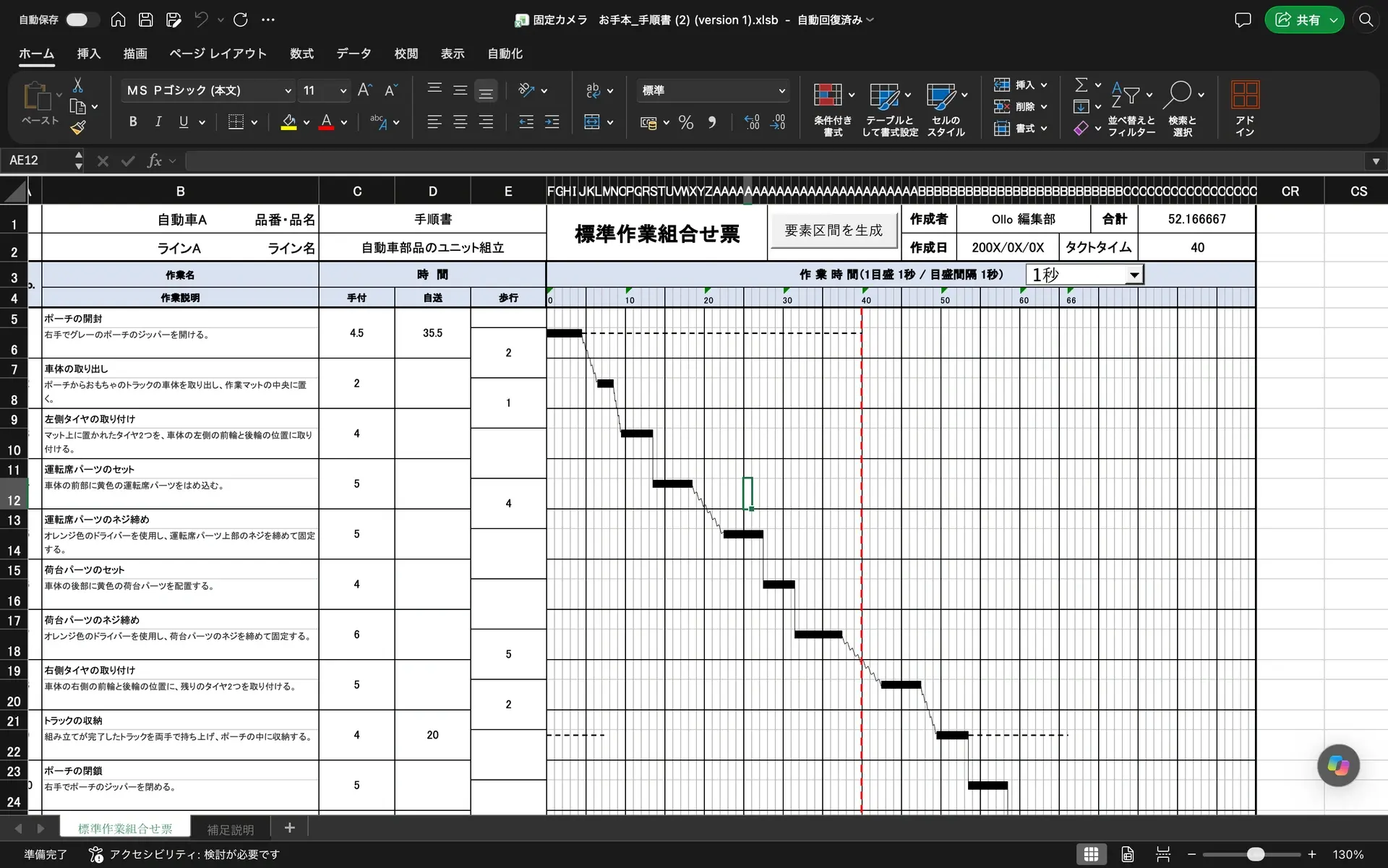 Official demo screen from Ollo Factory.
Visualize waste with AI-powered operational analysis.
Our AI-powered work analysis system automatically extracts cycles from long-duration work videos, allowing you to identify variations in timing and differences in tasks. It can also be used to classify tasks using AI and determine which actions are being used most frequently.

Ollo Factory provides comprehensive on-site training and improvement services, from creating video manuals to comparing and optimizing work processes.
If you're having trouble implementing JIT , please refer to the Ollo Factory documentation.
Request information from Ollo Factory.
Watch Ollo Factory’s Work Analysis in Action
About the author
K.Y. | Business Development Lead & Marketing, Ollo Inc.
K.Y. leads business development and marketing at Ollo Inc., an AI startup originating from the Matsuo Laboratory at the University of Tokyo and the developer of Ollo Factory, a work analysis AI for manufacturing.
After studying engineering and design at university, K.Y. joined a major automaker and worked on new electric-vehicle development, from design through factory production, including hands-on assembly-line training. K.Y. later worked in sales and marketing at a manufacturing startup.
Today, K.Y. helps manufacturing teams use AI to improve the way they work through Ollo Factory.
Back to articles
Related articles
See how Ollo Factory can support your factory
Book a demo
• See the product in action
• Discuss your production needs
• Explore available plans
Book a demo

Request a brochure
• Customer stories
• Key features
• How to get started
