

Published:
Lean Improvement
What Is the Toyota Production System?

The Toyota Production System addresses challenges such as reducing inventory, eliminating waiting times in processes, and minimizing variations in work performance by reviewing and improving quality and the flow of materials together.
This article clarifies the relationship between the two pillars of the Toyota Production System and Kanban, standard work, and continuous improvement. Using the assembly of automotive parts as an example, it explains where to start checking on the factory floor.
- What is the Toyota Production System? A philosophy for improving quality and workflow.
- The two pillars of the Toyota Production System
- Automation: Identifying and stopping abnormalities.
- Just-in-time: Get what you need, when you need it, and in the quantity you need.
- How are Kanban, standard work procedures, and improvement related?
- An example of considering the Toyota Production System in unit assembly.
- How to proceed when implementing it in the field
- 1. Confirm the overall process flow and any problems encountered.
- 2. Examine the difference between the standard and the actual result.
- 3. Test the countermeasures and revert to the standard method if it proves effective.
- Common misconceptions
- Summary: The Toyota Production System integrates quality and workflow.
- Ollo Factory: A manufacturing-specific AI for work analysis that supports everything from video analysis to standardization and training.
- Standardize video manuals so that AI can detect anomalies.
- Establish a system for video manuals created using comparative analysis AI.
- Visualize waste, inconsistency, and inefficiency with AI-powered operational analysis.
- The AI-powered improvement suggestion tool extracts potential solutions.
- AI for evaluating work posture visualizes the strain on workers' postures.
- Watch Ollo Factory’s Work Analysis in Action
What is the Toyota Production System? A philosophy for improving quality and workflow.
The Toyota Production System, also known as TPS (Toyota Production System), is a production system designed to deliver required products with high quality, without waste, and at the right time.
Focusing solely on reducing inventory and staff can lead to stockouts, unreasonable workloads, and overlooking quality issues. It's crucial to eliminate the causes of stagnation in goods and information one by one, while prioritizing making work easier for employees.
When trying to understand the Toyota Production System, before delving into individual tools, you should grasp the following two pillars.
The two pillars of the Toyota Production System
Automation: Identifying and stopping abnormalities.
Automation is not simply about making machines operate automatically. It's a way of thinking that involves detecting abnormalities, stopping equipment or operations when abnormalities occur, and preventing problems from being passed on to subsequent processes.
In the case of unit assembly, a system should be considered to not treat a state where fastening is not completed as finished, but rather to report abnormalities and take appropriate action. To enable on-site identification of unusual conditions, good product conditions, work standards, and communication and recovery methods must be defined, standardized, and established.
The process doesn't end with simply installing equipment; it also involves investigating the cause of the malfunction and implementing improvements to prevent recurrence. The mechanisms for verifying quality and the safety features for protecting people need to be considered separately.
Just-in-time: Get what you need, when you need it, and in the quantity you need.
Just-in-time (JST) is a concept of producing and delivering only what is needed, when it is needed, and in the required quantity. It involves establishing a system that connects processes, such as receiving what the next process needs and replenishing what the previous process has used.
The idea is not to mass-produce and stockpile parts used in unit assembly, but rather to match usage with replenishment. However, if inventory is reduced without ensuring sufficient replenishment capacity or quality, shortages will occur, halting operations.
It is necessary to understand the workflow and reduce waste, inconsistency, and inefficiency. Confirm the required inventory and replenishment time, and streamline the flow while improving process capacity, setup, and supply methods.
How are Kanban, standard work procedures, and improvement related?
Ways of thinking and methods | role | Things to check on site |
|---|---|---|
sign | Information regarding pickup and replenishment is communicated between processes. | What to replenish, how many, and from where? |
Standard operations | Establish standards such as work sequence, time, and standard hand size. | Do the actual movements match the standards? |
visualization | To be able to distinguish between normal and abnormal | What happens, and who makes the decision? |
improvement | Eliminate the gap between standards and reality, as well as waste and inefficiency. | How have quality, safety, and time changed? |
Simply distributing Kanban boards or creating standard work forms is not enough to establish a successful TPS (Toyota Production System). Each of these is used to maintain quality and facilitate the flow of materials and information.
The explanation of lean manufacturing methods by J-Net21 of the Organization for Small & Medium Enterprises and Regional Innovation, Japan, is also a useful reference for understanding its relationship with TPS (Toyota Production System). Rather than standardizing terminology, it is important to confirm with stakeholders the method that suits the conditions on site.
An example of considering the Toyota Production System in unit assembly.
For example, suppose parts are supplied in bulk from the previous process, but the assembly line is interrupted because the necessary parts cannot be found. The following is an example illustrating the concept of verification.
First, determine which part numbers are missing or delayed, and when. It's important to distinguish between searching for parts and the actual situation of parts not arriving. Having a large inventory doesn't necessarily mean all the necessary parts are available.
Next, we check the assembly usage, replenishment timing, container units, and remaining stock after part number changes. After changing the storage location or replenishment rules for parts, we check for shortages, search time, amount of work-in-progress, and occurrence of mix-ups.
Furthermore, we avoid making changes that would omit post-fastening checks in order to speed up the process. We assess whether the process will flow smoothly and with good quality, considering not only time but also quality and safety conditions.
How to proceed when implementing it in the field
1. Confirm the overall process flow and any problems encountered.
Before looking at just one person's actions, check the preceding and succeeding processes, parts supply, inspection, and transportation. Even if you improve the efficiency of your own process, if work-in-progress accumulates in the subsequent processes, the overall flow will not improve.
Determine the target product numbers and time period, and gather the necessary information such as output, work in progress, stoppages, rework, and working hours.
2. Examine the difference between the standard and the actual result.
We check the work sequence, equipment automation time, walking, and parts preparation on the same timeline. Standard work sheets and man-machine charts are used as needed.
To track the time spent on human work, automated feeding, and walking on a single timeline, the Standard Work Combination Sheet, one of the three standard work forms, is useful. For instructions on how to fill it out and examples, please refer to the [Free Template] How to Fill Out the Standard Work Combination Sheet | Examples and How to Read the Timeline .
Instead of simply looking for workers who are slower than average, investigate the factors that cause the differences, such as part numbers, layout, tools, skill level, and interruptions.
3. Test the countermeasures and revert to the standard method if it proves effective.
After confirming quality and safety, we make small changes to the layout, sequence, and supply method. We equalize the conditions before and after the change and measure the impact on time, quality, burden, and preceding/following processes.
Effective methods should be reflected in procedures, standard operations, training, and supplementation rules. For instructions on creating procedures and examples, please refer to the [Free Template] How to Create Work Procedures | Templates with Photos and Examples . Free templates with photos are also available.
When the actual situation on the ground changes, we will review our standards and ensure that we can continue to improve them.
If you want to streamline the measurement and comparison of work processes, or create improved procedure manuals, you can also utilize AI that analyzes videos.
Common misconceptions
All inventory should be reduced to zero: the required quantity changes depending on demand, replenishment capacity, and fluctuations. Don't just reduce inventory alone.
The more automated equipment there is, the closer it is to a TPS (Total Productivity System): If the judgment of abnormalities and the standards for work are ambiguous, waste and defects may be automatically created.
TPS is an activity that speeds up operations on the factory floor: it improves workflow while maintaining ease of work and quality, without increasing unnecessary movements.
Summary: The Toyota Production System integrates quality and workflow.
Understanding automation and just-in-time as two main pillars.
Use Kanban cards and forms according to their purpose, and don't make their creation the goal itself.
Verify the actual work and processes, and reflect the improved methods in standards and training.
AI can be used for measuring and comparing work processes, and for creating improved procedure manuals. By organizing the necessary information from videos, it becomes easier to free up time for on-site decision-making and improvements.
Ollo Factory: A manufacturing-specific AI for work analysis that supports everything from video analysis to standardization and training.
Ollo Factory uses AI to analyze work videos and supports everything from training to improvement. It also provides support when implementing TPS (Total Workplace Management System). You can utilize five functions: AI video manuals , AI comparative analysis , AI work analysis , AI improvement suggestions , and AI work posture evaluation .
Standardize video manuals so that AI can detect anomalies.
The AI-powered video manual system automatically divides uploaded work videos into steps and generates task names and descriptions. It can also import existing procedure manuals as reference materials and output data in your company's Excel spreadsheet format. This feature allows you to create a foundation for manuals used to determine whether a procedure is abnormal or not.
 Demo screen from the Ollo Factory official website.
Establish a system for video manuals created using comparative analysis AI.
The comparative analysis AI compares two work videos, such as one of a model and one of a newcomer, to identify differences in the time and movement of individual tasks. By reviewing the video to identify areas of difference, you can consider points for instruction and practice. The video manual AI helps ensure the adoption of manuals it creates, supporting the realization of automation.
 Demo screen from the Ollo Factory official website.
Visualize waste, inconsistency, and inefficiency with AI-powered operational analysis.
The AI-powered work analysis system categorizes work videos into segments and aggregates and visualizes the time spent on each segment. You can set classification criteria tailored to your specific work environment, such as work, movement, and waiting time. This helps identify the difference between the standard and actual performance.
 Demo screen from the Ollo Factory official website.
The AI-powered improvement suggestion tool extracts potential solutions.
The AI-powered improvement suggestion tool extracts potential problems from work videos and presents improvement proposals. You can review specific scenes in the video and consider improvement measures suitable for your specific situation. Based on the identified problems and areas for improvement, it can generate a list of potential solutions for implementation on-site.
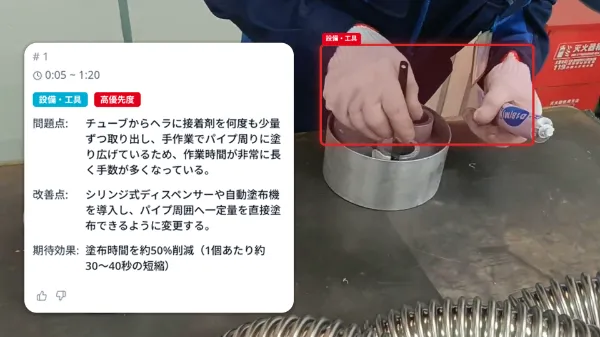 Demo screen from the Ollo Factory official website.
AI for evaluating work posture visualizes the strain on workers' postures.
The AI-powered work posture evaluation system analyzes the skeletal structure from full-body work videos and evaluates posture using the OWAS and REBA methods. It allows for evaluation of individual task elements and time-series strain analysis, and enables users to review results by changing conditions such as load. This eliminates unnatural work practices, improving both safety and productivity.
 Official demo screen from Ollo Factory.
Ollo Factory provides comprehensive on-site training and improvement services, from creating video manuals to comparing and optimizing work processes.
If you are having trouble successfully implementing the Toyota Production System , please refer to the Ollo Factory materials.
Request information from Ollo Factory.
Watch Ollo Factory’s Work Analysis in Action
About the author
K.Y. | Business Development Lead & Marketing, Ollo Inc.
K.Y. leads business development and marketing at Ollo Inc., an AI startup originating from the Matsuo Laboratory at the University of Tokyo and the developer of Ollo Factory, a work analysis AI for manufacturing.
After studying engineering and design at university, K.Y. joined a major automaker and worked on new electric-vehicle development, from design through factory production, including hands-on assembly-line training. K.Y. later worked in sales and marketing at a manufacturing startup.
Today, K.Y. helps manufacturing teams use AI to improve the way they work through Ollo Factory.
Back to articles
Related articles
See how Ollo Factory can support your factory
Book a demo
• See the product in action
• Discuss your production needs
• Explore available plans
Book a demo

Request a brochure
• Customer stories
• Key features
• How to get started
