

Published:
Manufacturing DX
What Is a Smart Factory? Steps and Manufacturing Examples

Even if you start collecting data on equipment and operations, the burden on the factory floor won't decrease unless it leads to improvements. What's important in a smart factory is not just making the data viewable, but using it for decision-making and improvement.
This article explains the meaning of smart factories, their relationship to IoT, AI, and manufacturing DX, and how to implement them starting from a single process. Using the assembly of automotive parts as an example, it will specify what to measure and how to verify the effects.
- What is a smart factory? A factory that uses data to connect decision-making and improvement.
- Relationship between IoT, AI, and manufacturing DX
- Determine what to improve in a smart factory.
- Education: Connecting procedures with actual work
- Productivity: Specifying stoppages and delays
- Quality: Matching results with the conditions under which they occur.
- Four stages to advance smart factories, starting from a single process.
- 1. Determine the problem and the current situation.
- 2. Collect only the data necessary for making a decision.
- 3. Try countermeasures based on data.
- 4. Verify the effectiveness and operational burden before deploying.
- Examples of using work videos: Connecting education and improvement
- Summary: Smart factories should start with what can be improved.
- Ollo Factory: A manufacturing-specific AI for work analysis that supports education and improvement from work videos.
- AI-powered video manuals support on-site work standardization.
- Connecting procedures and actual work using comparative analysis AI
- AI-powered operational analysis visualizes downtime and delays.
- The AI-powered improvement suggestion tool extracts potential problems.
- AI-powered work posture evaluation system visualizes the strain on workers' postures.
- Watch Ollo Factory’s Work Analysis in Action
What is a smart factory? A factory that uses data to connect decision-making and improvement.
A smart factory is a factory concept that uses digital technology to understand information about equipment and operations, and utilizes this information for decision-making and improvement in areas such as production, quality, and maintenance. It does not simply mean making all processes unmanned or increasing the number of robots.
For example, it can be used to collect data on equipment downtime, identify conditions that increase downtime, and verify the effectiveness of countermeasures. Even in human assembly work, video and time data can be used to investigate variations in work processes and differences in training methods.
The important thing is to connect "having data" to "who makes what decisions and changes what." Before adding more items to display, decide which issues you want to improve.
Relationship between IoT, AI, and manufacturing DX
term | Main role | Example in unit assembly |
|---|---|---|
IoT | Data such as status and performance is obtained from equipment, etc. | Collect records of the operation and shutdown of fastening equipment. |
AI | Processing and analyzing data such as images, text, and numerical data. | Analyze the data from the fastening equipment to identify any problems. |
Smart factory | Connecting data obtained from IoT and AI to on-site decision-making and improvement. | We will investigate the causes of the problems detected by AI and review the layout and procedures. |
Manufacturing DX | Leveraging data obtained from smart factories to transform operations, organization, and value proposition. | The results of the improvements will be applied to training and operations at other locations. |
Technologies such as IoT and AI are essential for realizing smart factories.
However, simply introducing one technology won't solve everything. We select the necessary technologies and operations to match the factory's objectives.
Determine what to improve in a smart factory.
Education: Connecting procedures with actual work
Instead of judging whether someone has mastered the procedure simply by looking at the work procedure manual, we check whether they can perform the procedure and verify it during actual work. If we can identify the differences between their performance and the example, we can specify what needs to be taught again.
Instead of comparing workers solely on speed, we also consider whether they are adhering to quality and safety requirements.
For instructions on how to create easy-to-understand work procedure manuals and examples, please check out the [Free Template] How to Create Work Procedure Manuals | Templates with Photos and Examples . Free templates with photos are also available.
Productivity: Specifying stoppages and delays
Simply compiling output figures may not reveal where time is being wasted. We need to separate and examine the time spent by equipment downtime from the time spent by people searching for parts or interruptions in work.
For unit assembly, dividing the process into "fastening," "inspection," and "parts preparation" makes it easier to identify areas where the overall cycle is prolonged. It's also effective to review footage of the longer-running cycles, not just the average.
The time spent on each of these individual tasks can also be measured using a time study with a stopwatch and recording paper. Before starting digital measurements, it's helpful to measure manually once to determine which tasks should be digitized. For instructions and examples, please refer to the [Free Template] How to Conduct a Time Study | Measurement Sheet and Example .
Quality: Matching results with the conditions under which they occur.
We will correlate not only the number of defects, but also the part number, equipment, lot number, settings, and work method. If the timestamp or the product in the data does not match, there is a risk that unrelated information may be treated as the cause.
Even if the cause is identified, the results will be checked under the same conditions after the countermeasures are implemented. Please distinguish between the values before and after a change in the testing method and any apparent improvement.
Four stages to advance smart factories, starting from a single process.
1. Determine the problem and the current situation.
Moving beyond the goal of "making the factory more visible," we define specific issues such as "the working time for Unit A varies from day to day." We standardize the target product number, number of people, work area, and measurement period, and record the current status.
IPA's DX Promotion Guide for Small and Medium-Sized Manufacturing Companies can also be used when considering how to utilize digital technologies in the manufacturing sector. Don't just paint a grand picture of the finished product; start by organizing your current situation and goals.
2. Collect only the data necessary for making a decision.
If you want to investigate delays in work, try to see if you can make a judgment using video or equipment records from a single process before installing sensors throughout the entire factory. Determine the required particle size and the burden of continuous collection.
Can it be matched to the target part number, equipment, and work?
Are the definitions of time, units, and classifications consistent?
Can you manage permissions for storage, viewing, and removal?
If using video, be sure to explain the process to the workers and confirm the filming rules within the factory, and film only the necessary areas.
3. Try countermeasures based on data.
Once we identify the actions that are causing the delay, we consider the placement of parts, the order of operations, jigs, and training. We don't conclude the cause based solely on numerical changes; we combine this with confirmation of the actual product and the worker themselves.
Changes to equipment conditions or inspections should be confirmed with the relevant departments and tested on a small scale. By deciding who will review the data and what decisions will be made during the trial period, you can prevent a situation where records simply accumulate without any real progress.
4. Verify the effectiveness and operational burden before deploying.
Before and after implementing the countermeasures, standardize the product numbers, number of personnel, scope of work, and inspection conditions, and then verify productivity, quality, and workload. Please also evaluate the time required for data organization and verification of AI results.
Once the system proves effective, we will refine the procedures, training, and classification rules and then expand them to other processes. Leaving different names and aggregation methods at each location unaddressed will necessitate adjustments every time we need to make comparisons.
Examples of using work videos: Connecting education and improvement
In the Nissan Motor case study published by Ollo , we can see how they utilize work videos for analysis and skill transfer. What's noteworthy here is their approach of not just saving the videos, but also identifying differences in work processes and using them for training and improvement planning.
This case cannot be used as evidence that the entire factory can be made smarter, or that the same effects can be achieved in all processes. Verification by your own company, tailored to the specific conditions of the process in question, is necessary.
For example, if there is a lot of searching for parts during unit assembly, check the number and duration of searches and measure whether they decreased after rearranging the parts. Also, check whether the rearrangement has increased the burden of mix-ups or replenishment.
The use of AI to visualize, standardize, and educate on work processes, starting from a single step, is introduced in Ollo Factory's product documentation.
Summary: Smart factories should start with what can be improved.
Determine the issues you want to improve and select the necessary data.
By combining numerical data, video footage, and physical objects, the person in charge can determine the appropriate course of action.
We will verify the effectiveness and operational burden, then establish procedures and training before deployment.
For tasks performed by humans, AI can be used to assist with video classification, time tracking, and procedure manual creation. It's also possible to test a single-step process, from analysis to training, before undertaking a major equipment upgrade.
Ollo Factory: A manufacturing-specific AI for work analysis that supports education and improvement from work videos.
Ollo Factory provides comprehensive support from training to improvement, including manual creation and improvement suggestions based on on-site work videos. It utilizes five functions: AI-powered video manuals , AI-powered comparative analysis , AI-powered work performance analysis , AI-powered improvement suggestions , and AI-powered work posture evaluation .
AI-powered video manuals support on-site work standardization.
The AI-powered video manual system automatically divides uploaded work videos into steps and generates task names and descriptions. It can also import existing procedure manuals as reference materials and output them in your company's Excel spreadsheet format.
 Demo screen from the Ollo Factory official website.
Connecting procedures and actual work using comparative analysis AI
The comparative analysis AI allows you to compare two work videos, such as one of a model and one of a newcomer, to identify differences in the time and movements of individual tasks. You can then examine the sections where differences exist in the video and consider points for instruction and practice.
 Demo screen from the Ollo Factory official website.
AI-powered operational analysis visualizes downtime and delays.
The AI-powered work analysis system divides work videos into segments, classifies them, and aggregates and visualizes the time spent on each segment. Classification criteria can be set to suit the specific work environment, such as work, movement, and waiting time.
 Demo screen from the Ollo Factory official website.
The AI-powered improvement suggestion tool extracts potential problems.
The AI-powered improvement suggestion system extracts potential problems from work videos and proposes improvements. You can then review specific scenes in the video and consider improvement measures that are appropriate for your specific situation.
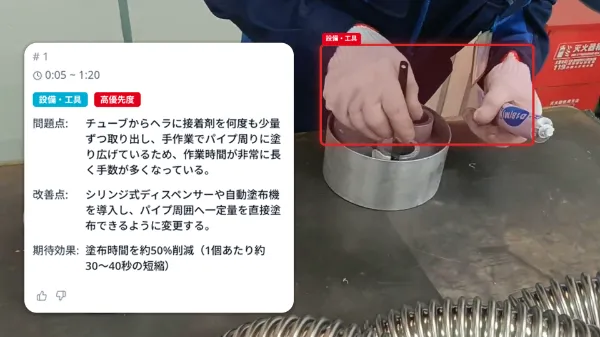 Demo screen from the Ollo Factory official website.
AI-powered work posture evaluation system visualizes the strain on workers' postures.
The AI for evaluating work posture analyzes the skeletal structure from full-body work videos and evaluates posture using the OWAS and REBA methods. It allows for evaluation of individual task elements and review of workload over time, and the results can be revised by changing conditions such as load.
 Demo screen from the Ollo Factory official website.
Ollo Factory is an AI service that is easy to adopt as a first step towards a smart factory because it can analyze data using only on-site video, without the need to introduce new IoT machines or sensors.
If you are struggling to implement a smart factory , please refer to the Ollo Factory materials.
Request information from Ollo Factory.
Watch Ollo Factory’s Work Analysis in Action
About the author
K.Y. | Business Development Lead & Marketing, Ollo Inc.
K.Y. leads business development and marketing at Ollo Inc., an AI startup originating from the Matsuo Laboratory at the University of Tokyo and the developer of Ollo Factory, a work analysis AI for manufacturing.
After studying engineering and design at university, K.Y. joined a major automaker and worked on new electric-vehicle development, from design through factory production, including hands-on assembly-line training. K.Y. later worked in sales and marketing at a manufacturing startup.
Today, K.Y. helps manufacturing teams use AI to improve the way they work through Ollo Factory.
Back to articles
Related articles
See how Ollo Factory can support your factory
Book a demo
• See the product in action
• Discuss your production needs
• Explore available plans
Book a demo

Request a brochure
• Customer stories
• Key features
• How to get started
