

Published:
Manufacturing DX
How to Plan Digital Transformation in Manufacturing

Many manufacturing companies want to advance digital transformation (DX), but don't know where to start. In such cases, introducing tools before clarifying the issues can simply increase the workload of data entry and management.
This article explains how to determine the scope of implementation based on on-site challenges, and how to proceed by confirming its effectiveness and adoption.
- What is manufacturing DX? How does it differ from smart factories? Connecting digitalization to business transformation.
- Choose a theme for manufacturing DX based on problems encountered on the factory floor.
- Five stages to advance DX in manufacturing
- 1. Determine the objective and target process.
- 2. Measure the current workload and conditions.
- 3. Consider the system to be implemented and determine the rules for operations and data.
- 4. Test on a small scale and evaluate the implementation process.
- 5. Standardize effective methods and decide on their deployment.
- Example of a plan to update the unit assembly procedure manual
- Points to note to avoid overestimating the effects of implementation
- The implementation plan will be linked to the existing improvement plan.
- Summary: Manufacturing DX transforms both on-site challenges and operations.
- Ollo Factory is a manufacturing-specific AI for work analysis that enables digital transformation of analysis, procedures, and training from a single video.
- Standardize work procedures with AI-powered video manuals.
- Establish a system for video manuals created using comparative analysis AI.
- Use AI for operational analysis to understand current workload and other factors.
- The AI-powered improvement suggestion tool extracts potential solutions.
- AI-powered work posture evaluation system visualizes the strain on workers' postures.
- Watch Ollo Factory’s Work Analysis in Action
What is manufacturing DX? How does it differ from smart factories? Connecting digitalization to business transformation.
Manufacturing DX is an initiative that leverages digital technology and data to transform the operations, organizations, and value propositions involved in manufacturing. While digitizing paper documents is a starting point, if only the file format changes and the work on the factory floor remains unchanged, the effects will be limited.
For example, in the case of procedure manuals, we don't just create PDFs; we ensure that the latest version reaches the field, that changes are explained, and that the knowledge is confirmed through actual work. In this way, we consider how the methods of updating and training themselves may change.
On the other hand, a smart factory is a concept for factories that uses digital technology to grasp information about equipment and operations, and utilize it for decision-making and improvement in areas such as production, quality, and maintenance. In other words, a smart factory is one of the ideal forms that factories should aim for, while manufacturing DX refers to the entire initiative that transforms operations, organization, and the value provided, including the smart factory itself.
For more information on smart factories, please refer to " What is a smart factory? How to implement it in a factory and examples of its implementation ."
IPA's DX Promotion Guide for Small and Medium-Sized Manufacturing Companies is a valuable resource when considering digital transformation in the manufacturing sector. Don't treat it as merely a tool implementation for your own department; connect it to your business goals and the challenges you face on the factory floor.
Choose a theme for manufacturing DX based on problems encountered on the factory floor.
Challenges on site | Tasks I want to change | Examples of metrics to check |
|---|---|---|
We can't keep up with updating the procedure manuals. | Creation, confirmation, approval, and distribution process | Time required for creation and verification per item, remaining old versions |
Work time varies | Methods for measurement, comparison, and improvement | Cycle distribution under the same conditions, conditions for occurrence of cycles that take a long time |
Education is concentrated among veterans. | Learning materials and methods for confirming mastery. | Training and verification time, and verification results until independent work is completed. |
The numerical values should be selected to correspond to the tasks you want to improve. Simply increasing the number of times a tool is used does not necessarily mean that productivity or quality has improved.
Five stages to advance DX in manufacturing
1. Determine the objective and target process.
Before making changes to the entire factory at once, determine what the problems are and how to change whose work. Narrowing down the target product numbers, processes, workers, and timeframes makes it easier to determine the necessary data and collaborators.
If the update targets the unit assembly procedure manual, you need to decide whether to include not only the "time spent writing the document" but also taking photos, checking quality requirements, approval, and distribution.
2. Measure the current workload and conditions.
Without current data, it's impossible to determine what improved after implementation. We'll divide the process into creation, verification, and modification, and record the number of items and the effort required.
We will keep separate records of actual measurements and the 담당자's (person in charge's) estimates. Do not use a single instance of a quick job as the average performance; please also note that differences can arise depending on the part number and the state of the documentation.
There are two methods for measuring current man-hours: time studies and work sampling. Time studies are suitable for measuring the man-hours of repetitive tasks over multiple cycles, while work sampling is suitable for understanding the man-hours of tasks whose content changes each time, such as creating procedure manuals.
The procedure for time studies and a free measurement sheet are introduced in [Free Template] How to Conduct a Time Study | Measurement Sheet and Example . For information on work sampling, please see How to Conduct Work Sampling | Observation Items, Frequency, and Aggregation Considerations .
3. Consider the system to be implemented and determine the rules for operations and data.
Once your current position and goals are determined, you will consider which system to use. At the same time, you will decide who will create and review the new system. Even when using AI, the responsibility for approving quality and safety requirements remains.
Data: Ensure consistency in correspondence between part numbers, process names, classifications, document numbers, etc.
Roles: Determine the creator, reviewer, approver, and updater.
Permissions: Check the conditions for viewing, storing, and externally using videos and drawings.
We will also check the connections with existing procedures and core systems. However, it is not necessary to automate everything from the start. We will differentiate between the connections that are necessary during the trial phase and those that will be finalized later.
4. Test on a small scale and evaluate the implementation process.
We will use the same tasks and materials to go through a cycle of current methods and proposed implementations. For example, when creating procedure manuals, we won't stop at the AI output; we'll measure the time required for manual revision, confirmation, and approval by the person in charge.
For example, even if a draft can be created quickly, if revisions to on-site terminology and formatting are required each time, the effort involved will be included in the evaluation. The ability to ensure consistent content regardless of who uses it is a key condition for widespread adoption and established use.
5. Standardize effective methods and decide on their deployment.
Once the effectiveness and burden have been confirmed, the input method, verification criteria, and handling of changes will be documented. After confirming that it will continue to be used in the target process, it will be expanded to similar part numbers or other processes.
If the trial results are unsatisfactory, we will review the scope and the way we conduct our work. It is important not to increase usage simply because it has already been implemented.
Example of a plan to update the unit assembly procedure manual
The following is an example explanation for considering an implementation plan. It does not demonstrate actual reduction results or the effectiveness of Ollo Factory.
item | What to decide |
|---|---|
Issues and Scope | The task of updating the procedure manual for Unit A is concentrated on the assigned personnel. |
Understanding the current situation | Measure the number of items and the amount of work involved in shooting, drafting, checking, revising, and distributing. |
Consideration and rule setting | We are considering introducing AI-powered video manuals, and creating a system where site supervisors review drafts generated by the AI. |
Trial and evaluation | Create a draft from a video recording of approved work procedures and output it to an existing form. Compare the total effort required (including verification), the number of omissions, and the ease of updating. |
Conditions for establishment | Determine the verifiers/approvers and the method for managing the latest version. |
This plan involves not only increasing the number of procedure manuals created, but also determining what aspects to focus on, including post-change training and verification of actual work. This is because if the data for analysis, training materials, and mastery verification remain separate, re-entry and discrepancies in content will remain.
For details on how AI can be used to connect video analysis, procedure manual creation, and training, please refer to the Ollo Factory product documentation.
Points to note to avoid overestimating the effects of implementation
The monetary value obtained by reducing man-hours is different from the actual reduction in expenses. We will show the difference between whether overtime and outsourcing costs are reduced, and whether the freed-up time is used for improvements.
Furthermore, when calculating and summing the effects of work analysis and training separately, we ensure that the same time savings are not counted twice. The burden of initial setup, training, data preparation, and operational management is also included in the evaluation.
Security and network constraints can easily halt plans if investigated only immediately before implementation. Please involve on-site, quality, and IT stakeholders in the trial phase to confirm these issues.
The implementation plan will be linked to the existing improvement plan.
There's no need to create separate management sheets solely for manufacturing DX. The following information can be accessed through existing improvement plans and approval documents.
Target tasks/processes, current workload and problems, goals and deadlines
The measures to be tested, the necessary data and permissions, and the person responsible for implementation and verification.
Trial results, increased workload for verification and updates, and the decision on whether to deploy.
When creating procedure manuals, compare not only the creation time but also the time spent on review, revision, and approval. Confirm that the process is sustainable before expanding the scope to include specific product numbers or processes.
Summary: Manufacturing DX transforms both on-site challenges and operations.
Determine the tasks you want to improve, and clearly define the target and current values.
This includes testing the AI output, including verification and correction, as well as operational management.
We will verify the effectiveness and adoption of the product, standardize it, and then deploy it.
Using the same video for work analysis, procedure creation, and training makes it easier to verify content across departments. A possible approach would involve using AI to assist with drafting and data compilation, allowing humans to focus their time on quality, safety, and improvement decisions.
Ollo Factory is a manufacturing-specific AI for work analysis that enables digital transformation of analysis, procedures, and training from a single video.
Ollo Factory uses AI to analyze work videos and supports everything from training to improvement. It can be used as the first step in manufacturing DX. Ollo Factory has five functions: video manual AI , comparative analysis AI , work analysis AI , improvement suggestion AI , and work posture evaluation AI .
Standardize work procedures with AI-powered video manuals.
The AI-powered video manual system automatically divides uploaded work videos into steps and generates step names and descriptions. It can also import existing procedure manuals as reference materials and output them in your company's Excel spreadsheet format. It can also be used for updating manuals.
 Demo screen from the Ollo Factory official website.
Establish a system for video manuals created using comparative analysis AI.
The comparative analysis AI allows you to compare two work videos, such as one of a model and one of a newcomer, to identify differences in the time and movements of individual tasks. You can examine the sections with differences in the video and consider points for instruction and practice. Thiscan help ensure that manuals created with the video manual AI are properly implemented.
 Demo screen from the Ollo Factory official website.
Use AI for operational analysis to understand current workload and other factors.
The AI-powered work analysis system categorizes work videos into segments and aggregates and visualizes the time spent on each segment. You can set classification criteria tailored to your specific work environment, such as work, movement, and waiting time. This helps identify the difference between target and actual performance.
 Demo screen from the Ollo Factory official website.
The AI-powered improvement suggestion tool extracts potential solutions.
The AI-powered improvement suggestion tool extracts potential problems from work videos and presents improvement proposals. You can review specific scenes in the video and consider improvement proposals that are suitable for your specific situation. Based on the problems and improvements, it can create a list of potential solutions for implementation on-site.
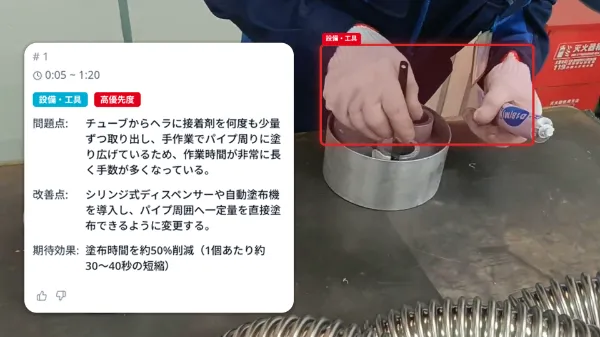 Demo screen from the Ollo Factory official website.
AI-powered work posture evaluation system visualizes the strain on workers' postures.
The AI-powered work posture evaluation system analyzes the skeletal structure from full-body work videos and evaluates posture using the OWAS and REBA methods. It allows for evaluation of individual task elements and time-series strain analysis, and enables users to review results by changing conditions such as load. This helps identify unnatural work practices and facilitates the consideration of strain reduction and improvement.
 Demo screen from the Ollo Factory official website.
Ollo Factory provides comprehensive on-site training and improvement services, from creating video manuals to comparing and optimizing work processes.
If you want to go beyond analysis and advance your DX to include standardization and education , please refer to the Ollo Factory materials.
Request information from Ollo Factory.
Watch Ollo Factory’s Work Analysis in Action
About the author
K.Y. | Business Development Lead & Marketing, Ollo Inc.
K.Y. leads business development and marketing at Ollo Inc., an AI startup originating from the Matsuo Laboratory at the University of Tokyo and the developer of Ollo Factory, a work analysis AI for manufacturing.
After studying engineering and design at university, K.Y. joined a major automaker and worked on new electric-vehicle development, from design through factory production, including hands-on assembly-line training. K.Y. later worked in sales and marketing at a manufacturing startup.
Today, K.Y. helps manufacturing teams use AI to improve the way they work through Ollo Factory.
Back to articles
Related articles
See how Ollo Factory can support your factory
Book a demo
• See the product in action
• Discuss your production needs
• Explore available plans
Book a demo

Request a brochure
• Customer stories
• Key features
• How to get started
