

Published:
Lean Improvement
How to Prevent Human Error in Manufacturing

Despite being instructed to "thoroughly check everything," the same mistakes of forgetting to tighten bolts or mixing up parts still occur. Human error prevention in manufacturing requires not only increased worker attentiveness, but also a review of easily misplaced items, procedures, and methods for resuming work after interruptions.
This article explains how to identify the cause of an error, select countermeasures, and verify their effectiveness, using the assembly of automotive parts as an example.
- What is human error? Distinguishing between mistakes and defects.
- Three stages in implementing measures to prevent human error
- 1. Stop the impact and preserve the facts of what happened.
- 2. Choose a mechanism that suits the cause.
- 3. Verify the effect under the same conditions.
- A concrete example of checking for forgotten tightening during unit assembly.
- Records to keep as a measure against human error
- FAQ
- Can this be prevented by increasing the number of double-checks?
- Can AI prevent all human errors?
- Summary: Address human error by identifying the conditions under which it occurs.
- Ollo Factory is a manufacturing-specific AI for work analysis that supports work comparison and procedure standardization.
- Use operational analysis AI to pinpoint areas where errors are likely to occur.
- Use AI to suggest improvements and identify potential solutions.
- Standardize improved work processes using AI-powered video manuals.
- Use comparative analysis AI to establish improved work processes.
- Watch Ollo Factory’s Improvement Suggestions AI in Action
What is human error? Distinguishing between mistakes and defects.
Human error occurs when a person's judgment or actions deviate from the intended outcome. In manufacturing settings, this can manifest as mistaking parts, skipping steps, or incorrectly entering settings.
Even if an error occurs, it may be possible to prevent defective products from reaching the next stage of production if the issue is stopped by a jig or verification. Conversely, a single mistake may go undetected until a later stage, leading to rework and delays in delivery. Therefore, it is important to investigate both "why the mistake occurred" and "why it went undetected" separately, and to consider countermeasures from both the perspective of preventing occurrence and preventing defects from reaching the next stage.
What happened | Conditions to investigate | Measures to prevent occurrence | Measures to prevent leakage |
|---|---|---|---|
Similar parts were mistaken for each other. | Location, identification markings, and verification during assembly. | Separation and arrangement, checking remaining items during switchover. | Part Number Verification |
After the interruption, I forgot to tighten one bolt. | Recording the interruption point and resuming the process, and confirming the number of fastened items. | Display of restart location | Check the number of items and do not send incomplete items to the next process. |
I worked with different settings. | How to access and modify settings, and verification procedures at the start of work. | Restricting the ability to recall and modify settings linked to the product number. | Initial setup confirmation |
The table is an example for considering countermeasures. Please confirm the actual cause by examining the actual item, work records, and interviewing those involved.
Three stages in implementing measures to prevent human error
1. Stop the impact and preserve the facts of what happened.
If defects or safety issues are suspected, the first step is to stop, isolate, and contact the relevant authorities according to on-site rules. This prevents the affected lot or work-in-progress from being lost before the cause investigation can begin.
Next, gather the following information.
When, in which process, product number, and with which equipment, what happened?
To what extent has it affected them, and what kind of emergency measures have been taken?
What were the work procedures, parts, tools, labels, and records like before and after the incident?
Simply stating "the new employee was careless" doesn't identify the conditions for recurrence. Instead, describe the observed circumstances, such as "work was interrupted for part replacement, and fastening resumed without any indication of the correct position." Do not fill in any unknown points with speculation; leave them as unconfirmed.
2. Choose a mechanism that suits the cause.
We will select countermeasures after identifying the cause. If the arrangement makes mix-ups likely, we will consider methods such as increasing the number of labels, separating similar parts, supplying them one part at a time, and verifying part numbers, in addition to increasing the number of labels.
Our top priority is creating a structure that minimizes the likelihood of errors occurring. A jig that only allows parts to be placed in the correct orientation is one example. If that's difficult, we'll consider a system that detects incorrect part numbers or incomplete processes and prevents them from proceeding to the next stage. Procedure manuals and training will be used in conjunction with this system to ensure it's used correctly and that abnormalities are handled appropriately.
For improvement ideas, please also refer to " 10 Improvement Suggestion Ideas for Factories | Specific Examples of Unit Assembly and How to Write a Proposal ."
The Ministry of Health, Labour and Welfare's accident case studies involving tire molding machines also indicate measures to review safety devices, the location of control panels, procedures for non-routine operations, and training. It is important not to try to solve safety-related problems solely through warnings and training.
3. Verify the effect under the same conditions.
Even if no errors occur after implementing countermeasures, if the production volume or the affected product numbers have changed, it cannot be judged as an effective measure. The number of times the target operation is performed, the definition of the error, and the observation period must be standardized.
For example, when investigating the effectiveness of measures to prevent forgetting to tighten bolts, in addition to determining "how many out of how many machines experienced the problem," you should also check whether the restart method can be used even when the work is interrupted. Checking under conditions where the error occurred, such as part number changes, work by support staff, and tool changes, in addition to normal operation, makes it easier to find gaps in the countermeasures.
Once the effectiveness is confirmed, we will reflect it in the procedures, labeling, and training, and then continue the practice by deciding on a review schedule with the person in charge.
For information on how to create procedure manuals and examples, please also see "[Free Template] How to Create Work Procedure Manuals | Templates with Photos and Examples" .
A concrete example of checking for forgotten tightening during unit assembly.
Let's say a single bolt is found to have been left loose during the assembly of an automotive part unit. The following is a hypothetical example illustrating the approach to the investigation.
The work video shows that the process was interrupted by a delay in parts supply, and as a result, one step in the fastening sequence was skipped. However, we will not conclude that the interruption was the cause based solely on the video. We will confirm with the worker, record the fastening tools used, and compare them with the restart rules in the procedure manual.
If, after checking, a method for preserving the restart position has not been decided, we will consider position markings or confirming the number of completed items. Furthermore, we will test whether placing markings will hinder the removal of parts or cause misidentification with different part numbers.
By combining these steps—"finding differences through video," "confirming the cause with the actual object and records," and "verifying the results through work after implementing the countermeasures"—we can create a solution that goes beyond simply retraining workers.
The AI function that allows users to check the differences between the example and the actual work through video and then use that information to create corrective procedures and training materials is described in the product documentation.
Records to keep as a measure against human error
To verify the effectiveness of the countermeasures after they are implemented, record the facts of the incident and the details of the countermeasures taken in existing defect records and improvement records. Rather than creating new forms, let's make sure the following information is available in a place where all relevant parties can access it.
The facts of what happened, the affected product numbers and processes, the scope of impact, and emergency measures.
Hypothesis about the cause, evidence to support it, and countermeasures taken.
Responsible party, deadline, conditions for confirming effectiveness, and confirmation results.
For example, to address the hypothesis that "the restart location after the interruption was misidentified," we would use videos from before and after the interruption, as well as the results of our interviews with the individual involved. Even after implementing countermeasures, we would retain records of production numbers and target conditions so that we can analyze why the error did not occur.
FAQ
Can this be prevented by increasing the number of double-checks?
Simply reviewing the same labels using the same methods may lead to repeating the same mistakes. Determine the items, criteria, and timing for verification, and if possible, combine them with other mechanisms such as part number verification or process completion conditions. Also, check whether increasing the number of inspections will complicate the work.
Can AI prevent all human errors?
AI alone cannot guarantee quality and safety. Video analysis helps identify differences and omissions in work processes, allowing for revisions to procedures and training. Conditions not visible in the video, as well as approved manufacturing conditions, must be verified through physical samples and records.
Summary: Address human error by identifying the conditions under which it occurs.
Instead of relying solely on human attention, investigate the layout, procedures, and how to handle interruptions.
We need to consider methods to prevent the occurrence of the problem and methods to prevent it from leaking into subsequent processes separately.
The effectiveness of the process will be verified by standardizing the number of repetitions and conditions, and this information will be reflected in the procedure manual and training.
Reviewing work videos before and after implementing countermeasures becomes more burdensome as the number of processes increases. By using AI to classify and compare tasks and create draft procedure manuals, those responsible can dedicate more time to verifying the cause and deciding on countermeasures.
Ollo Factory is a manufacturing-specific AI for work analysis that supports work comparison and procedure standardization.
Ollo Factory is an AI-powered work analysis system specifically designed for the manufacturing industry. It uses AI to analyze work videos and supports everything from training to improvement.
By utilizing AI for operational analysis , improvement suggestion , video manuals , and comparative analysis , we support everything from investigating areas prone to human error to improvement and training.
Use operational analysis AI to pinpoint areas where errors are likely to occur.
The AI-powered work analysis system classifies work videos, allowing you to identify variations in timing and differences in actions. Because it can classify long videos, it can pinpoint areas with significant timing variations or situations where procedures tend to be disrupted.
 A demo screen from the official Ollo website.
Use AI to suggest improvements and identify potential solutions.
The AI improvement suggestion tool extracts potential problems from work videos and proposes improvement plans. Improvement plans can be considered based on the locations of human errors identified by the operational analysis AI.
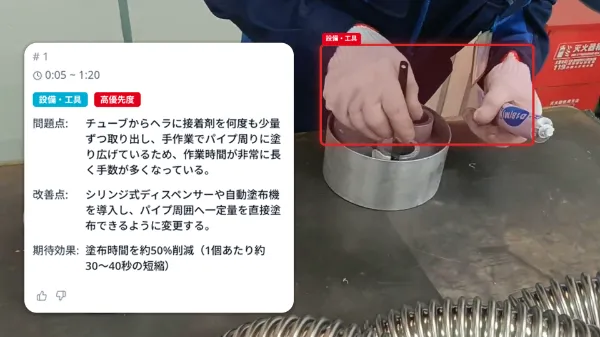 A demo screen from the official Ollo website.
Standardize improved work processes using AI-powered video manuals.
The AI-powered video manual tool automatically divides uploaded work videos into steps and generates step names and descriptions. The improved work processes can then be compiled into manuals for standardization and training. It can also import existing Excel templates and output the steps in that format.
 A demo screen from the official Ollo website.
Use comparative analysis AI to establish improved work processes.
The comparative analysis AI can compare two work videos, such as one of a model and one of a newcomer, to identify differences in the time and movements involved in individual tasks. It can also compare multiple cycles, allowing you to narrow down potential areas where errors are likely to occur. Furthermore, it can be used to check how well the corrective measures have been implemented and how effectively they have been retained after being incorporated into training.
 A demo screen from the official Ollo website.
Ollo Factory is used by automakers such as Nissan and Suzuki , and provides comprehensive support from on-site improvements to standardization and training after those improvements are implemented.
If you want to streamline everything from investigating and correcting human errors to providing training using AI, please see the Ollo Factory materials.
Request information from Ollo Factory.
Watch Ollo Factory’s Improvement Suggestions AI in Action
About the author
K.Y. | Business Development Lead & Marketing, Ollo Inc.
K.Y. leads business development and marketing at Ollo Inc., an AI startup originating from the Matsuo Laboratory at the University of Tokyo and the developer of Ollo Factory, a work analysis AI for manufacturing.
After studying engineering and design at university, K.Y. joined a major automaker and worked on new electric-vehicle development, from design through factory production, including hands-on assembly-line training. K.Y. later worked in sales and marketing at a manufacturing startup.
Today, K.Y. helps manufacturing teams use AI to improve the way they work through Ollo Factory.
Back to articles
Related articles
See how Ollo Factory can support your factory
Book a demo
• See the product in action
• Discuss your production needs
• Explore available plans
Book a demo

Request a brochure
• Customer stories
• Key features
• How to get started
