

公開日:
Training & Standardization
How to Create Work Instructions with Ollo Factory

Ollo Factory allows you to create a draft of a procedure from a work video, review and revise the description, and output to videos or Excel and confirm points before use in the field. This article introduces the workflow from shooting to editing and output, and points to confirm before use in the field.
- What is AI-powered automatic creation of work procedures? Mechanism and effectiveness
- Five reasons why traditional work manual creation becomes inefficient.
- The basic flow for creating a work procedure book with AI consists of the following five steps.
- Traditional procedure book creation vs. AI-generated procedure book creation
- Creating step-by-step instructions for Ollo Factory | 5-step process
- First, shoot the work.
- STEP 3. Starting analysis in step-by-step instruction creation mode
- Step name, work content, work time
- Video manualization
- STEP 5. Downloading in CSV format or standard work combination ticket format
- Three points to improve the accuracy of AI analysis by shooting the work video | 3 points
- Ollo Factory Implementation and Proof of Concept – Suzuki J-TREC
- Case 1. Suzuki Co., Ltd. – Official Introduction at Domestic Factory
- Case 2. Company for Comprehensive Vehicle Production (J-TREC) – Proof of Concept in Railway Vehicle Manufacturing
- Frequently Asked Questions (FAQ)
- Q1. Can factory work instructions be created by AI?
- Q2. What should be prepared to create work instructions by AI?
- Q3. How much time can be saved using the Work Manual Creation AI?
- Yes. In Ollo Factory, AI analyzes the process based on the work video and assists in creating the work procedure. Furthermore, you can use the created procedure as a video manual and
- Using the AI-generated work procedure or video manual, you can
- It is recommended to first
- Q8. Can a procedure be created from a work video even for dynamic assembly lines or outdoor work?
- Compatible with wearable camera footage, overcoming the dead spots of fixed cameras. In dynamic environments where the work area is wide, such as the completion vehicle assembly process of Nissan Motor Company, where workers dive under the car body or enter the car body, work analysis and procedure creation are possible.
- Output to the required format, obtain user confirmation and approval, and deploy on the site.
- Ollo Factory, a manufacturing-specialized work analysis AI, can automate the creation of procedural documents from work videos.
- Watch Ollo Factory’s Video Manual AI in Action
What is AI-powered automatic creation of work procedures? Mechanism and effectiveness
AI-powered automatic creation of work procedures is a mechanism that analyzes work videos and automates the division of processes, generation of procedure names, and measurement of work time.Yes. Traditionally, shooting, entering text, and pasting images were done manually by humans, but with AI, a draft of the procedure can be created by simply uploading the video.
In the manufacturing field, while DX is progressing, the creation of work procedures and work manuals still relies on methods such as "doing it from scratch manually" and "printing and storing on paper" in many factories. In the manufacturing industry, where technology transfer is urgent, the situation where procedure creation does not keep up with work becoming specialized is a major risk.
This article introduces,Specific methods for automatically creating work procedures in the factory with AIand,How to efficiently streamline new employee education and technology transferExplains the topic of work manuals using the Ollo Factory, a manufacturing-specialized work analysis AI case study.
Five reasons why traditional work manual creation becomes inefficient.
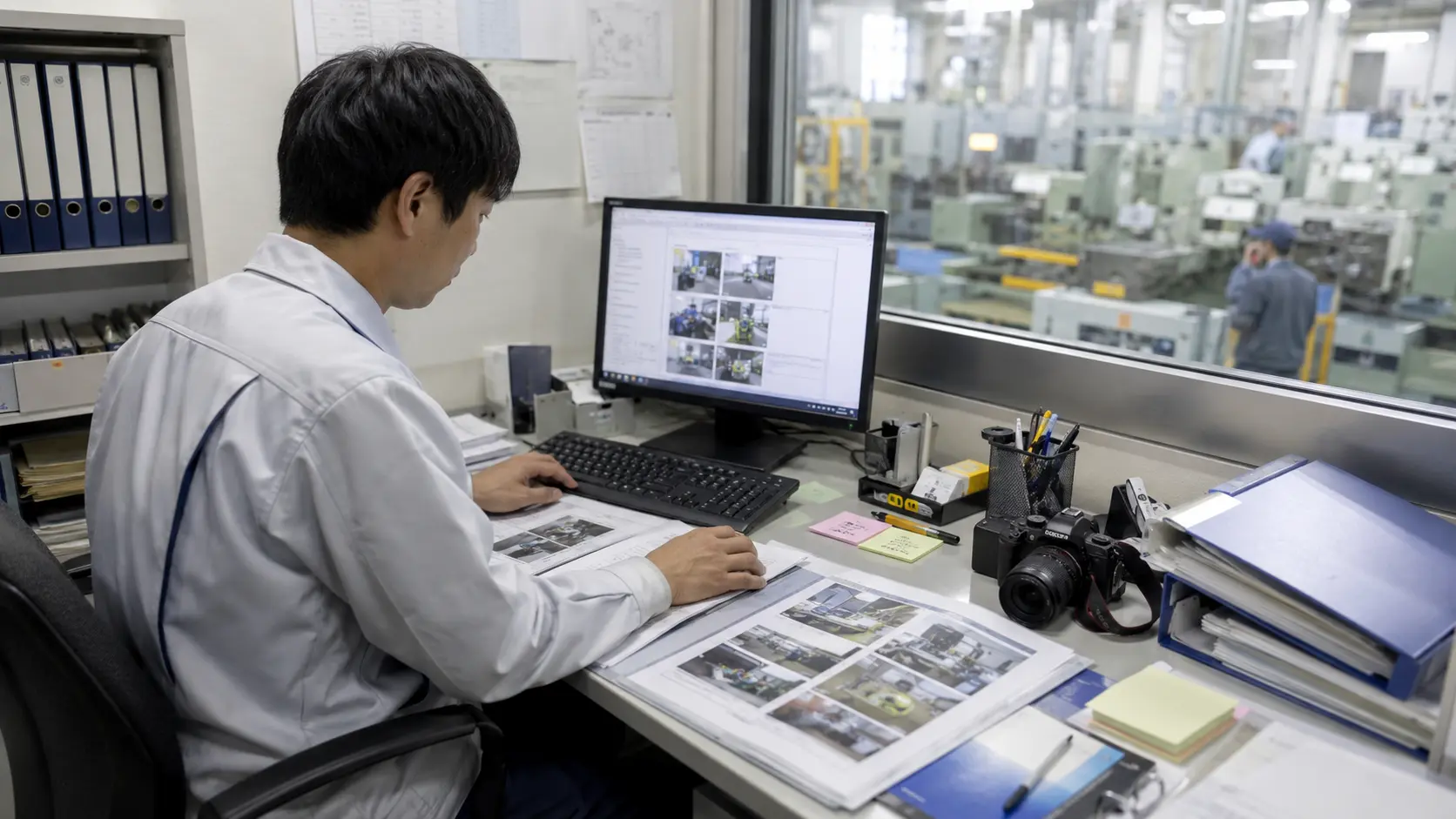
In traditional work procedure book creation, the following five processes must be performed manually.Manual work.Process.
Work content. | Estimated time for each process. | 1. Shooting. |
|---|---|---|
Photographing each page with a camera. | 30 minutes to 1 hour. | 2. Input. |
Keyboarding procedure name, work content, and notes. | 1 to 2 hours. | 3. Editing. |
Selecting photos and pasting them into the procedure book. | 1 to 2 hours. | 4. Supplementation. |
Adding figures and arrows for supplementation. | 30 minutes to 1 hour. | 5. Printing and storage. |
Printing and filing. | 30 minutes. | Even a mere 10 minutes of work can take several hours to a full day to create a procedure book using this method. |
Especially for education officers or field leaders who well understand the site, creating procedure books in parallel with regular tasks often leads to overtime and delayed work.As a result, the following problems occur.The procedure book remains outdated and is not updated.
New employee education relies on verbal explanations.
A gap in work quality between veterans and new hires emerges.
Standard work manuals are not established, leading to work becoming personalized.
The state of "wanting to create a work manual but lacking time" persists.
This "lack of time to create" state is the area most easily improved with AI utilization.
AI-assigned tasks and human-verified tasks.
How to create a work procedure book with AI.
The basic flow for creating a work procedure book with AI consists of the following five steps.

Creating work instructions from video with AI involves five main steps.
Traditionally, selecting photos and entering text took a lot of time. With AI, steps can be extracted from the work video, significantly reducing the effort required to create step-by-step instructions, and generating a draft of the instructions from the video. Before use in the field, the responsible person must review the work content, numbers, and judgment criteria, and make necessary corrections and approvals.
Furthermore,The true value of step-by-step instruction creationgoes beyond simply reducing the time required for creation. When step-by-step instructions are stored as data, they can be extended to field challenges such as standardizing operations, training new employees, and technology transfer. This is the greatest benefit of AI utilization.t051 | t052 | The most significant benefit of AI utilization is the extension of step-by-step instructions as data, enabling standardization of operations, training new employees, and technology transfer.makes it easier toStandardization of work, new employee training, technology transfert054 | Traditional step-by-step instruction creation vs. AI-generated step-by-step instructions
Traditional procedure book creation vs. AI-generated procedure book creation
Comparison items | Traditional step-by-step instruction creation | AI-generated step-by-step instruction creation |
|---|---|---|
Required skills | Shooting, editing, and text creation | Shooting and confirming/correcting output content |
Updating effort | Redoing from scratch each time | Responding to video replacement |
Video manualization | Separate video editing required | Output possible from the same data |
Extension to standard work manuals | Reconstruction in Excel | Output in CSV and standard work combination ticket formats |
Creating step-by-step instructions for Ollo Factory | 5-step process
The manufacturing industry-specialized work analysis AI "Ollo Factory" has functions such as step-by-step instruction creation, work classification, problem detection, and proposal of improvement measures. Here,Introducing the 5-step process for step-by-step instruction creation using "Ollo Factory Tools" that supports standardizing operationsSTEP 1. Shooting the work
First, shoot the work.
It is important to shoot so that the work operator's hands, tools, parts, and work object are as visible as possible.STEP 2. Uploading the work video to AIUpload the shot video to Ollo Factory Tools. If existing step-by-step instructions or part information exists, utilizing them makes it easier to create step-by-step instructions that are more suitable for the field.
STEP 3. Starting analysis in step-by-step instruction creation mode
Starting analysis in step-by-step instruction creation mode, AI analyzes the work video and automatically divides the work process. After creation,
Step name, work content, work time
can be edited.Automatic creation of step-by-step instructionsSTEP 4. Using the step-by-step instruction as a video manual

Video manualization
STEP 5. Downloading in CSV format or standard work combination ticket formatThe completed step-by-step instructions can be downloaded in CSV format, video-included PowerPoint format, and standard work combination ticket format, depending on the purpose.CSV format, video-included PowerPoint format, and standard work combination ticket format for Ollo Factory Tools

STEP 5. Downloading in CSV format or standard work combination ticket format
The completed step-by-step instructions can be downloaded in CSV format, video-included PowerPoint format, and standard work combination ticket format, depending on the purpose.CSV format, video-included PowerPoint format, and standard work combination ticket formatfor Ollo Factory Tools

Three points to improve the accuracy of AI analysis by shooting the work video | 3 points
When creating step-by-step instructions with AI,the accuracy of analysis depends on how the video is shot. Be aware of the following 3 points to make it easier to create more practical step-by-step instructions.
Photograph at a clear angle showing the worker's hands, tools, and parts
Ensure the worker cannot see the screen
Avoid overlapping with other workers or equipment too much
AI can streamline procedure creation, but it cannot fully determine site-specific safety standards, quality standards, or precautions. Ultimately, it is important for the site-understanding personnel to confirm and standardize the work instructions.
Ollo Factory Implementation and Proof of Concept – Suzuki J-TREC
The following is the overall Ollo Factory implementation and proof of concept. This is not a case measuring only procedure creation effects.
Ollo Factory is used in automobiles and railway vehicles,Major manufacturers in the manufacturing industry are adopting itHere are two representative company cases.
Case 1. Suzuki Co., Ltd. – Official Introduction at Domestic Factory
Suzuki Co., Ltd. introduced Ollo FactoryIn July 2025 at the assembly workshop of the Asahara Factory and officially introduced it in December 2025 at the engine workshopAs part of the Suzuki Smart Factory concept, digitalization of the site and real-time monitoring are enhancing work analysis, education, and quality control in the production site.
The domestic factory is positioned as a mother production base, using it to visualize work variability, skill transfer of skilled workers, and consolidation of standard work procedures. It is also working on real-time anomaly detection to immediately detect work omissions and work mistakes such as forgetting to tighten screws.
Learn more:Suzuki, introducing Ollo Factory work analysis AI in domestic factories

Case 2. Company for Comprehensive Vehicle Production (J-TREC) – Proof of Concept in Railway Vehicle Manufacturing
Company for Comprehensive Vehicle Production (J-TREC) is advancing trial introduction of Ollo Factory through the JR East Japan Startup Program.
In railway vehicle manufacturing, there are many important tasks where multiple people collaborate and skilled workers' know-how is crucial. By using Ollo Factory, it supports procedure creation from work videos, new worker education, and mistake prevention, aiming to enhance railway vehicle manufacturing technology and productivity.

Frequently Asked Questions (FAQ)
Q1. Can factory work instructions be created by AI?
Yes, they can be created. By uploading work videos to AI, the work flow can be automatically analyzed, and the creation of work instructions and work manuals can be supported. Ollo Factory can, based on the work videos of the manufacturing site, split the procedures, organize work names, and create video manuals.
Q2. What should be prepared to create work instructions by AI?
Standardize the preparation of a model work video.Capture the work area, tools, parts, and work object so they are visible.This makes it easier for AI to analyze the work content. If existing procedures or part names are available, combining them can improve accuracy.
Q3. How much time can be saved using the Work Manual Creation AI?
Traditionally, tasks such as photo capture, text entry, image pasting, and printing could take several hours to a full day.This was sometimes the case. With AI, uploading the work video allows the creation of the procedure document to proceed, significantly reducing the workload. The analysis time varies depending on the video capacity and network environment.Q4. Can you automatically create a work procedure or video manual from the video?
Yes. In Ollo Factory, AI analyzes the process based on the work video and assists in creating the work procedure. Furthermore, you can use the created procedure as a video manual and
Add subtitles and graphics.Create easily usable materials for new employee training and on-the-job training.Q5. How can AI be used for new employee training and technical knowledge transfer?
Using the AI-generated work procedure or video manual, you can
Uniform the content of new employee training.Also, by recording the video of veteran workers and converting it into a procedure, it becomes easier to preserve the implicit knowledge of actions and work tips. This can reduce the explanation time of the education manager and formalize the technical knowledge transfer system.Q6. Can the AI-generated procedure be used directly on the site?
It is recommended to first
Have the site manager or education manager confirm it. Safety precautions, quality standards, and internal rules vary by site, so by basing the AI output on human final confirmation and correction, it can be used as a practical standard work manual.Q7. Can it be introduced in a factory with only paper procedures?Yes, it can be introduced. Based on existing paper procedures, new procedure and video manual can be developed by combining work videos. Even in sites where paper manuals have not been updated, digital transformation can be easily advanced with AI.
Q8. Can a procedure be created from a work video even for dynamic assembly lines or outdoor work?
Yes, it is possible. Ollo Factory is
Compatible with wearable camera footage, overcoming the dead spots of fixed cameras. In dynamic environments where the work area is wide, such as the completion vehicle assembly process of Nissan Motor Company, where workers dive under the car body or enter the car body, work analysis and procedure creation are possible.
Summary: Create a draft from the video, confirm the site standard, and output.Define the target work and shooting range, and prepare a video where parts and hands are visible.Correct the generated procedure and description by aligning it with the approved work conditions.
Output to the required format, obtain user confirmation and approval, and deploy on the site.
Automating the transcription of procedures and the creation of description text with AI makes it easier to spend time on confirmation and improving educational content.
Example of filling out a photo-accompanied procedure.
Output to required format, user confirmation and approval, then deploy to the field.
Automating the transcription of procedures and the creation of explanatory text with AI makes it easier to allocate time for review and improvement of training content.Example of a filled-out procedure book with photosAlso, it can be used when verifying output.
Ollo Factory, a manufacturing-specialized work analysis AI, can automate the creation of procedural documents from work videos.
Ollo Factory supports the division of procedures, generation of explanatory text, and output to existing Excel-like formats. With field videos and ledgers, you can determine how much can be automated and where verification and correction are needed. Please refer to the materials for features and deployment examples.

Watch Ollo Factory’s Video Manual AI in Action
この記事の執筆者
株式会社Ollo
事業開発部リーダー マーケティング担当 Yoshida
製造業特化型の作業分析AI「Ollo Factory」を開発・提供する株式会社Ollo(東京大学 松尾研究室発のAIスタートアップ)で、事業開発とマーケティングを担当。
大学時代は工学部で設計開発を学び、新卒で大手自動車メーカーに入社。新型EVの開発グループで、設計から工場での生産まで幅広くプロジェクトに携わり、研修の一環として、実際に自動車製造工場でのライン作業も経験。その後、製造業領域のスタートアップで営業・マーケティングに従事。
現在は、製造現場でのAI活用を促進し、よりワクワクする働き方を実現できるよう、「Ollo Factory」の販売・マーケティングに取り組んでいる。
一覧に戻る
関連記事
Ollo Factoryについて、さらに詳しく。

まずは資料請求
・ 導入事例と効果
・ 主な機能
・ 活用の流れ
