

公開日:
Lean Improvement
10 Factory Improvement Ideas with an Assembly Example

Look for factory improvement opportunities by observingwhere and how often people search, carry, wait, or redo work. Build a proposal around observed facts, a likely cause, a trial, and a measure of success.
This article gives shop-floor leads and operators ten ideas and explains how to write a proposal. The example isan automotive component assembly operation. It is a hypothetical process covering loading a housing, fastening, connecting, inspecting, and handing off the unit.
- Start by observing where the work gets difficult
- Ten factory improvement ideas for automotive assembly
- Action and layout improvement proposals
- Quality and verification improvement proposals
- Record and education improvement proposals
- Monitor both quality and safety alongside time
- Expand scope from one process to adjacent processes
- 5 Steps to Find Improvement Ideas
- 1. Define the objective and target in one sentence
- 2. Record the current state
- 3. Organize causes as hypotheses
- 4. Try on a small scale
- 5. Verify effectiveness under the same conditions and reflect in the standard
- How to write an improvement proposal: Turn one idea into a workable format
- Calculate the amount and time of effect by showing the basis.
- Writing and correcting suggestions that are difficult to implement.
- Frequently asked questions about factory improvement proposals.
- Can small improvements be proposed?
- What do you look at first when there is no consensus?
- How will you use the before-and-after video?
- Summary: Turn observed facts into testable proposals.
- Manufacturing-specific work analysis AI "Ollo Factory" that can automate identifying problem points and creating improvement proposals.
- Watch Ollo Factory's Improvement Suggestion AI in the video.
- Watch Ollo Factory’s Improvement Suggestions AI in Action
Start by observing where the work gets difficult
Instructions such as “work faster” or “enforce 5S” leave the change unspecified. If one parts search took 12 seconds, document it and check part labels, supply locations, and part orientation.
Start with one part number and one defined task. Observe normal work and what happens just after replenishment, a product changeover, or an interruption. Ask operators where they hesitate and what information or material they need to proceed. Their answers can reveal conditions the recording misses.
Ten factory improvement ideas for automotive assembly
These measures are candidates. Verify site constraints and test them in small scale before adoption.
Action and layout improvement proposals
Notes | Observation points | Candidate improvement proposals | Verification of effects and side effects |
|---|---|---|---|
1. Locate parts | Compare similar parts in a box | Standardize the orientation and position of part labels | Search time, mispicks, and mixing during replenishment |
2. Transfer parts | Change orientation multiple times after retrieval | Reassess orientation and trays during supply | Number of transfers, installation defects, and replenishment effort |
3. Reaching tools | Retrieve tightening tools from a distance | Establish a fixed position where tools can be safely accessed | Reaching, physical strain, drops, and interference |
4. Walking and returning | Return to the part shelf one unit at a time | Reassess supply position and replenishment unit | Distance, supply operator round trips, and work-in-process quantity |
5. Temporary placement and reloading | Replace the unit on the intermediate platform | Align handover location and transport container | Reloading count, scratches, and next-stage acceptance conditions |
Quality and verification improvement proposals
Notes | Observation points | Candidate improvement proposals | Verification of effects and side effects |
|---|---|---|---|
6. Waiting for equipment completion | Nothing can be advanced until inspection is complete | Confirm monitoring conditions and review preparation sequence | Overlap of personnel and equipment time, safety, and tool availability |
7. Confirmation of part number switching | Remaining parts or labels from previous part number | Specify confirmation items and placement during switching | Switching errors, confirmation time, and missed confirmations |
8. Reinstallation | Identify orientation mismatches in downstream operations | Show identification points before installation with a photo | Re-work, misassembly outflows, and confirmation burden |
Record and education improvement proposals
Notes | Observation points | Candidate improvement proposals | Verification of effects and side effects |
|---|---|---|---|
9. Duplicate recording | Transcribe the same result to separate paper and ledger | Confirm recording purpose and organize format | Transcription time, recording omissions, and traceability |
Variability in teaching methods | Instructors differ in noting critical points and sequence | Standardize approved procedures and demonstration videos | Question content, adherence to procedure, and post-training reconfirmation |
Monitor both quality and safety alongside time
Even if tools are brought closer and cycle time improves, if movable equipment interferes, adoption is not possible. Even if confirmation is skipped and time is reduced, defects will flow to downstream processes, preventing improvement. The target for optimization is the portion where the method can be changed while maintaining necessary functionality.
Expand scope from one process to adjacent processes
Shorter supply distances may increase the number of round trips for replenishment personnel. Verify not only the assembly operator's time but also replenishment, inspection, and handover. Proposing the scope of improvement ideas in the report enables easier stakeholder confirmation.
5 Steps to Find Improvement Ideas
1. Define the objective and target in one sentence
Narrow the target and problem, such as "reduce time spent searching for parts during component installation." Do not address factory-wide issues at once; begin with an observable range.
2. Record the current state
The current state record includes the following three elements:
Work conditions: part number, operator, tools, method of part supply
Observed facts: time/count/quantity/distance and corresponding video timestamps
Record the date and time, the measurement method, and any items that were not measured.
Replace the impression of "frequent" or "slow" with facts; separate estimated values from actual measurements.
3. Organize causes as hypotheses
Do not make immediate assumptions based on "I found it, so the display is bad"; instead, investigate product code display, component mixing, orientation after replenishment, and how instructions are conveyed. Separate the observed facts from the unconfirmed causes.
4. Try on a small scale
Try with one shelf, one product code, and one work shift. Define the conditions for change and the conditions to revert, and confirm with the quality, safety, and related process managers. Trying multiple measures at once makes it difficult to determine which worked.
5. Verify effectiveness under the same conditions and reflect in the standard
Align measurement ranges and work conditions before and after the improvement. Once results are confirmed, reflect in the procedure sheet, tool and component fixed positions, and educational content, and check after a certain period whether it has returned to the original state.
Organize problems and improvement proposals from field videos, and if you want to streamline proposal creation, you can also use Work Analysis AI.
How to write an improvement proposal: Turn one idea into a workable format
Next, here is a hypothetical case study for reviewing component display.
Items | Example of entry |
|---|---|
Target and purpose | Retrieval of components for unit assembly. Reduce search time and mispicks |
Current facts | After replenishment, the product code display is hidden, and the box is lifted every time for confirmation |
Hypothesized cause | The orientation of the box is not fixed during replenishment, and the display position varies by box |
Measure | On one shelf, align the display position and orientation. Confirm with the replenishment person how to place the box |
Trial conditions | Compare with the same product code and supply method. If mixing occurs, stop the trial and review |
Confirmation indicators | Number of box lifts, presence or absence of mispicks, replenishment effort |
Implementation and confirmation | Include the responsible person, trial period, and quality and safety reviewers |
Method of stabilization | Update the replenishment procedure and photos after confirmation, and observe again later. |
Calculate the amount and time of effect by showing the basis.
If the searching time is12 seconds every time.If the time decreases, and the target is 200 times a day, 12 seconds × 200 times = 2,400 seconds, which means a reduction of 40 minutes of work time per day. However, observing 12 seconds only once does not mean "12 seconds decrease every time." Confirm the frequency and measurement after improvement before estimating.
Reducing work time does not necessarily mean increasing production volume. If equipment or downstream processes are constrained, speeding up only the assembly process may not increase the number of completed products. When showing the cost reduction of labor, separate which costs actually change.
Writing and correcting suggestions that are difficult to implement.
If only "be vigilant" is stated, add how to change the conditions that are easily mistaken, display/placement/procedure. If the proposal starts with "buy equipment," include the current frequency and impact, as well as small-scale testable ideas.
If the observation turns into criticism of the worker, return to the observed facts. "Newcomers are slow" is better than "there were 3 occasions to search for tools." This allows for joint consideration of teaching methods, tool fixed positions, and supply methods.
Frequently asked questions about factory improvement proposals.
Can small improvements be proposed?
Frequent short losses and changes to prevent mistakes are targets. Rather than showing large effects, demonstrate measurable facts and methods for verification.
What do you look at first when there is no consensus?
Observe one cycle and mark the work elements: "search, switch, wait, restart." Then ask the worker about the conditions under which these occur.
How will you use the before-and-after video?
Compare the same part number, work area, and supply conditions, and verify the altered operation and its impact on other stages. Assess speed, as well as missed checks and awkward postures.
Summary: Turn observed facts into testable proposals.
Record the "search, switch, wait" scenarios by time and count.
Separate the current facts, hypotheses for causes, countermeasures, and confirmation indicators in the proposal document.
Test on a small scale, confirming effectiveness across quality, safety, and downstream stages.
Use AI to automate reviewing videos to organize problem scenes for finding improvement ideas. Align candidates and evidence to ease confirmation of execution conditions and effect validation.
Manufacturing-specific work analysis AI "Ollo Factory" that can automate identifying problem points and creating improvement proposals.
Manufacturing-specific work analysis AI "Ollo Factory"ofImprovement proposal AIidentifies problem point candidates from work videos and automatically presents improvement ideas. It increases spontaneous ideas while allowing you to return to specific video scenes for review.
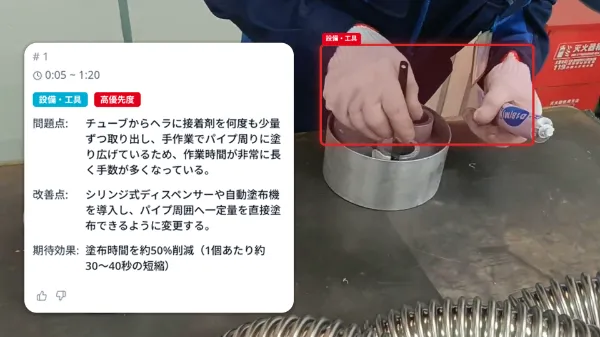
Official publication screen. The expected effects shown in the screen are AI estimates, not verified track records.
FurtherProduction analysis AIClassify work, movement, and waiting time to identify high-loss situations. Standardize classification criteria to streamline documentation for comparing before and after improvements.

Official publication screen. View video segment intervals and time by classification.
Verify implementation feasibility and effectiveness on-site.Manufacturing environment seeking improvement ideas from video and linking concrete proposals to validation.Check the appropriate function in the document.
Watch Ollo Factory's Improvement Suggestion AI in the video.
Watch Ollo Factory’s Improvement Suggestions AI in Action
この記事の執筆者
株式会社Ollo
事業開発部リーダー マーケティング担当 Yoshida
製造業特化型の作業分析AI「Ollo Factory」を開発・提供する株式会社Ollo(東京大学 松尾研究室発のAIスタートアップ)で、事業開発とマーケティングを担当。
大学時代は工学部で設計開発を学び、新卒で大手自動車メーカーに入社。新型EVの開発グループで、設計から工場での生産まで幅広くプロジェクトに携わり、研修の一環として、実際に自動車製造工場でのライン作業も経験。その後、製造業領域のスタートアップで営業・マーケティングに従事。
現在は、製造現場でのAI活用を促進し、よりワクワクする働き方を実現できるよう、「Ollo Factory」の販売・マーケティングに取り組んでいる。
一覧に戻る
関連記事
Ollo Factoryについて、さらに詳しく。

まずは資料請求
・ 導入事例と効果
・ 主な機能
・ 活用の流れ
