

Published:
Lean Improvement
The Three Actuals in Manufacturing: Go to the Place, See the Thing, Check the Facts

The "Three Realities Principle" is a way of thinking that involves going to the "actual site," verifying the "actual object," and making judgments based on "reality." Instead of determining the cause based solely on explanations heard in meetings or aggregated figures, it involves comparing actual movements, the state of the object, and records.
For example, even if you find that "it takes too long to find parts" during unit assembly, the placement isn't necessarily the only cause. You also need to investigate the timing of part number changes, shortages, and replenishment. This article explains what to check in each of the three areas (actual situation, actual place, actual place, actual place) and how to proceed with improvements based on the facts.
- The meaning of the three realities principle and the difference between the actual site, the actual object, and the reality.
- Situations where the three principles of reality, fact, and reality are necessary
- Five steps to determine the cause using the three-actual-actual-actual method
- 1. Narrow down what you want to verify to just one thing.
- 2. Observe the series of operations on-site.
- 3. Compare the physical object with the managed documents.
- 4. Test the hypothesis using records and the person's explanation.
- 5. Test the countermeasures on a small scale and verify them under the same conditions.
- Record the facts confirmed on-site and the hypotheses separately.
- The relationship between the Three Realities Principle and the Three Direct Three Realities Principle/Five Realities Principle
- Summary: The three-act principle is used to distinguish between facts and hypotheses.
- Ollo Factory: An AI-powered work analysis tool that uses on-site video footage for improvement and training.
- AI-powered improvement suggestion tool detects on-site problems and potential improvement proposals.
- AI-powered video manuals are used for post-improvement training.
- Watch Ollo Factory’s Improvement Suggestions AI in Action
The meaning of the three realities principle and the difference between the actual site, the actual object, and the reality.
Three realities | Confirm | Example of unit assembly |
|---|---|---|
On-site | The place and movement of work | The process involves removing parts, assembling them, and inspecting them. |
Actual item | The condition of the object in question | Similar parts, jigs, tools, markings, defective products |
reality | Actual events and problems | A record of when, with which product number, and how many times it occurred. |
In reality, this includes not only video footage and production records, but also what was observed on the spot. However, statements like "they must have been in a hurry" and "I think their training was insufficient" are not yet factual. We will treat the confirmed information and the interpretations separately.
Simply going to the site doesn't necessarily reveal the cause. We need to determine whether what we observed was normal work or an exception, and then compare the actual items with the records to make a judgment.
Situations where the three principles of reality, fact, and reality are necessary
When improvements aren't being made, it's often not because the cause is unknown, but because different events are being discussed using the same terminology. Simply saying "there are a lot of mistakes" doesn't distinguish between mix-ups, forgetting to fasten things, or skipping checks.
The explanations given for defects and work delays vary from person to person.
Despite taking countermeasures, the problem recurred, and I don't know what actually changed.
The conclusion was that the problem was due to the worker's lack of attention, and no concrete measures were decided upon.
In such cases, we gather all the relevant information before discussing the cause. For issues related to safety or leaks, we prioritize necessary initial actions such as isolation, shutdown, and communication, and then conduct investigations.
Five steps to determine the cause using the three-actual-actual-actual method
1. Narrow down what you want to verify to just one thing.
"Improving assembly efficiency" is too broad a subject to observe. It's better to specify the process and what's happening, such as "Identifying situations where work stops after a part number change due to the need to search for the housing."
First, organize the date, time, part number, equipment, lot number, and any differences from normal operation. If there is no record, leave it as unknown and decide how to fill in the gaps.
2. Observe the series of operations on-site.
We observe not only the moment of the problem, but also the actions before and after. If we're looking for a part, we also observe when it's replenished, when the part number is changed, and when the assembly process returns.
Sometimes, speaking to the animal can change its behavior. Record any unusual conditions and observe from a safe location. There is no need to intentionally reproduce dangerous behaviors or malfunctions.
3. Compare the physical object with the managed documents.
Check the shelf labels, the appearance of the parts, the containers, tools, jigs, and instruction manuals. Even if the correct part number is placed, the label may not be visible from the retrieval location.
When examining the actual product, we don't immediately conclude that it's the cause. Instead, we document it in a way that a third party can verify, such as "the display is oriented in the opposite direction to the work position" or "similar parts are adjacent." We also verify that the relevant version of the drawings and procedures is being applied.
4. Test the hypothesis using records and the person's explanation.
If the hypothesis is "it's searching because a similar part is nearby," then we investigate which part numbers are affected and whether it occurs under normal circumstances with the same arrangement. We then match the video timestamps, production records, and worker descriptions.
Content to record | Examples of how to write it |
|---|---|
Observed facts | After the product number was changed, I looked at the two containers alternately and stopped. |
Actual condition | Similar parts were located next to each other, and the display faced the aisle. |
hypothesis | It may be difficult to check the part number from the work position. |
Additional confirmation | Confirmation with the person concerned, comparison with normal conditions, and trial display changes. |
If there are multiple causes, we will not try to force them into a single cause. Equipment conditions and part dimensions that are not visible in the video will be supplemented using the actual items or management records.
5. Test the countermeasures on a small scale and verify them under the same conditions.
If you're going to try changing the display, determine the target product number and time period, and check how long it takes to find it and whether there are any mix-ups. If the production volume or product mix differs before and after the improvement, record the difference as well.
If the changes are effective, we will reflect this in signage, replenishment rules, procedures, and training. Don't just leave it at recording your visit or photography; make sure you document what you changed and how you verified the changes.
The AI function, which analyzes videos taken on-site to identify differences and timings in work processes and organizes clues for investigating the cause, is described in the product documentation.
Record the facts confirmed on-site and the hypotheses separately.
The investigation record should include the date, time, location, and product number of the item, as well as the basis for the judgment. More important than the format of the record is that another person can verify the same facts.
The movements observed on-site, the condition confirmed by the actual object, and the facts recorded.
Hypotheses that haven't been verified yet, and ways to further confirm them.
Person in charge of confirmation, deadline, investigation results, and next steps.
In addition to the impression that "the parts seemed difficult to pick up," describe the location where the parts were placed, the position from which you reached, and the specific circumstances under which you had to change your grip. If the relationship to the cause is unconfirmed, do not state it as a fact, but rather as a hypothesis.
The relationship between the Three Realities Principle and the Three Direct Three Realities Principle/Five Realities Principle
The "Three Direct, Three Realities" principle emphasizes the importance of directly verifying the site and the actual product, and listening directly to the person involved. The "Five Realities" principle adds principles and rules to the three realities. Since the usage of these terms may vary from organization to organization, please ensure that their meanings are consistent within your company.
In both cases, these methods are used to avoid making judgments based solely on impressions from what was observed on-site. Even when applying principles and rules, we avoid applying conclusions without verifying the actual conditions.
Summary: The three-act principle is used to distinguish between facts and hypotheses.
We compare on-site activity, the actual condition of the items, and the actual records.
We'll differentiate between what we've seen and what we've inferred, and then decide on additional verification methods.
We will test the countermeasures, check their effectiveness, and reflect the results in our procedures and training.
Videos are useful because they allow multiple people to review the same scene. Using AI to categorize and summarize tasks makes it easier to narrow down the scenes to observe, allowing more time to be spent on review and improvement.
Ollo Factory: An AI-powered work analysis tool that uses on-site video footage for improvement and training.
Ollo Factory is an AI-powered work analysis tool specifically designed for the manufacturing industry. It supports AI-based classification of work videos and comparison of work examples with target work examples.
By utilizing AI-powered improvement suggestion and AI-powered video manuals , it's possible to investigate potential causes from work videos and utilize the results for post-improvement training.
AI-powered improvement suggestion tool detects on-site problems and potential improvement proposals.
The AI improvement suggestion system identifies problems and proposes potential improvements based on work videos. By adding reference materials such as procedure manuals and safety standards, it can also be used for considerations based on your company's standards. The suggested improvements are verified by comparing them with the actual items and managed documents.
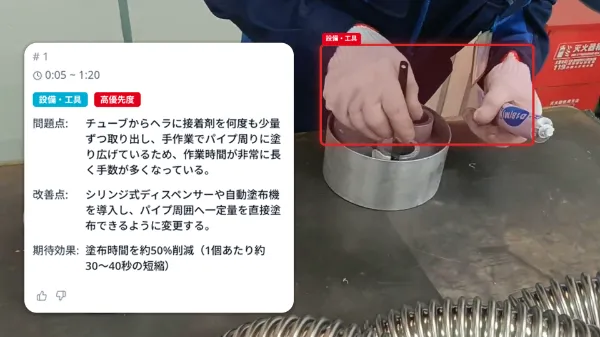 A demo screen from the official Ollo website.
AI-powered video manuals are used for post-improvement training.
The AI-powered video manual system automatically divides uploaded work videos into steps and generates task names and descriptions. The improved work processes can then be compiled into manuals, leading to standardization and training. The generated steps and descriptions are compared with approved procedure manuals and actual on-site practices, and modified as needed before being used for training.
 A demo screen from the official Ollo website.
The improvement suggestions proposed by the AI will be adopted after being compared with the actual product, equipment conditions, and quality and safety standards. Do not determine the cause solely based on the video analysis results; use them as material to further verify the three principles of "actual product, actual equipment
If you'd like to proceed from video-based root cause analysis to post-improvement training, please refer to the Ollo Factory materials.
Request information from Ollo Factory.
Watch Ollo Factory’s Improvement Suggestions AI in Action
About the author
K.Y. | Business Development Lead & Marketing, Ollo Inc.
K.Y. leads business development and marketing at Ollo Inc., an AI startup originating from the Matsuo Laboratory at the University of Tokyo and the developer of Ollo Factory, a work analysis AI for manufacturing.
After studying engineering and design at university, K.Y. joined a major automaker and worked on new electric-vehicle development, from design through factory production, including hands-on assembly-line training. K.Y. later worked in sales and marketing at a manufacturing startup.
Today, K.Y. helps manufacturing teams use AI to improve the way they work through Ollo Factory.
Back to articles
Related articles
See how Ollo Factory can support your factory
Book a demo
• See the product in action
• Discuss your production needs
• Explore available plans
Book a demo

Request a brochure
• Customer stories
• Key features
• How to get started
