

Published:
Shop-Floor Training & Skill Transfer
Why Video Manuals Alone Are Insufficient for Manufacturing Knowledge Transfer

Comparison of veteran and new worker tasks in the same segment reveals sequence, time gaps, and stumbling points. This article introduces a flow using Ollo Factory to AI-assisted comparison, recording, and linking to education and skill confirmation.
- Manufacturing technology transfer is insufficient with only video manuals.
- Fundamental reason why technology transfer is difficult in manufacturing
- Six reasons why video manuals alone are insufficient for skill transfer
- Five steps for skill transfer in manufacturing
- STEP 1. Visualizing the veteran's work
- Not too much movement to retrieve parts
- STEP 3. Standardize procedures as standard work
- STEP 4. Establish the standard in the field by comparing veterans
- STEP 5. Prevent work errors and stabilize quality
- How does technical transfer change with the use of AI?
- Starting with high-educational-load tasks
- It is recommended to start with high-educational-load tasks or tasks where quality differences are easily noticeable.
- Preserving the veteran's techniques
- Preserving the field's knowledge, making it easy to convey, and utilizing it for improvement.
- Ollo Factory supports the 5-step technical transfer process comprehensively.
- Visualization | Make veteran work visible through videos and data.
- Improvement | Detecting waste, waiting time, and dangerous work
- Standardization | Organizing as a procedure book and video manual
- Ollo Factory can also be used to confirm movements and work mistakes different from standard work. Early detection of work mistakes and missing procedures supports quality stabilization after education. Real-time anomaly detection can immediately detect missing work such as forgetting to tighten screws, contributing to preventing defective output. When a mistake occurs, reviewing the cause while watching the video makes it easier to link to prevention measures for recurrence and revision of standard work.
- Ollo Factory can also be used for confirming standard work and different movements or work mistakes. By linking early detection of work mistakes and missing procedures, it supports quality stabilization after education.
- AI Utilization in Manufacturing: Veteran vs. Newcomer Comparison Accelerates Improvement
- Case 1. Nissan Motor Company | Veteran vs. Newcomer Comparison in Finished Vehicle Assembly Process
- Suzuki Corporation formally introduced Ollo Factory
- JR East Japan Group: Launch of proof-of-concept for work analysis AI 'Ollo Factory' in railway vehicle manufacturing sites
- Can you determine mastery when time differences are minimal?
- Time difference alone is insufficient. Mastery is confirmed by verifying work sequence, safety and quality checks, and actions during anomalies—all within defined conditions. If necessary checks are skipped despite faster performance, mastery is not recognized.
- Can you determine mastery when the time difference is small?
- What do the two compared videos represent?
- Summary: Link video differences to instruction, and verify the ability to replicate the target task.
- The manufacturing-specialized work analysis AI "Ollo Factory" can automate video comparison and educational material creation.
- Watch Ollo Factory’s Video Manual AI in Action
Manufacturing technology transfer is insufficient with only video manuals.
To advance manufacturing technology transfer, creating video manuals alone is insufficient. What is truly needed is to visualize, improve, standardize veteran work as standard operations, establish comparison with veterans for on-site adoption, and confirm error-free execution.
In manufacturing, with veteran worker aging and labor shortages, the importance of technology transfer is increasing. Many factories are establishing work procedures and creating video manuals as countermeasures. Videos can capture hand movements and work flow that are difficult to convey in paper manuals, offering a significant advantage.
However, creating video manuals alone does not guarantee that new or young workers can work at the same quality and speed as veterans immediately. This is becauseRecording the work is not the only requirement for technology transfer.Therefore.
This article explains why technology transfer does not progress with only video manuals and how to visualize veteran work with AI, then establish it on-site.
Fundamental reason why technology transfer is difficult in manufacturing
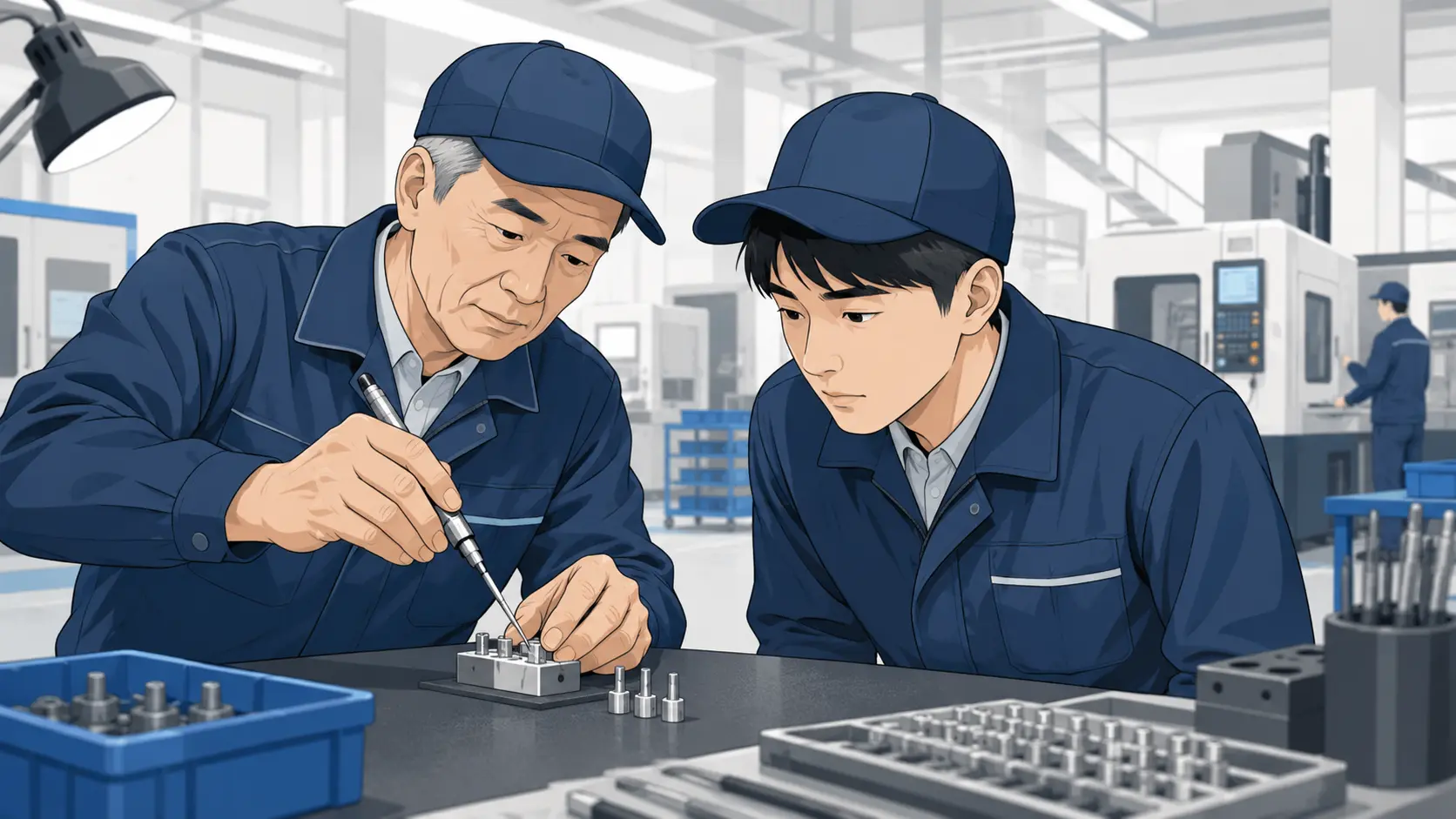
In manufacturing operations,Many operations are supported by long-term experience. For example, the following operations:Precise positioning of parts
Angle of tool application and hand movement
Standing position and procedure for smooth, safe movement
These operations cannot be adequately conveyed by "attach parts" and "visually confirm" in the procedure sheet alone. Actions that are routine for veterans may be unclear for newcomers regarding what to look at and where to pay attention to.
Additionally, education personnel and on-site leaders often conduct new worker education, procedure sheet creation, improvement activities, and quality response concurrently with regular duties, which often leads to the following problems.
Problems occurring on-site
Causes | Education content varies depending on the teacher |
|---|---|
Implicit knowledge is not verbalized | Newcomers cannot work at the same quality as veterans |
Difference from veterans is not visible | Delayed updates to procedure sheets and standard operation sheets |
High burden of creation and updates | In other words, |
The true reason technology transfer is difficult is that much of the work is "human experience," which cannot be conveyed by procedure sheets or verbal explanations alone.The real reason technical transfer is difficult is that much of the work is "human experience," which cannot be conveyed through manuals or verbal explanations alone.Yes.
Six reasons why video manuals alone are insufficient for skill transfer

Video manuals are highly effective as the first step in skill transfer. The ability to view actual operations in video makes it easier to understand the workflow than a paper instruction manual.
However, simply leaving a video cannot create a state that can be replicated on the site. For example, even if new employees watch a veteran's operation video, some points may be unclear, such as
Which actions are key points
Why the work is done in this order
Where quality differences are likely to appear
Which movements are wasteful and which are necessary
Where the new employee's work differs from the veteran's work
Whether work errors or missing steps are occurring
Also, as the number of video manuals increases,Management burdenBecomes greater. It may take time to find the required videos, or old videos may remain, making them difficult to use on the site.
Video manuals are effective as "viewing materials," but a separate mechanism is needed for "being able to do it."In skill transfer, it is important to leave a video not only to record operations but also to analyze, improve, standardize, and confirm the consolidation after education.
Five steps for skill transfer in manufacturing
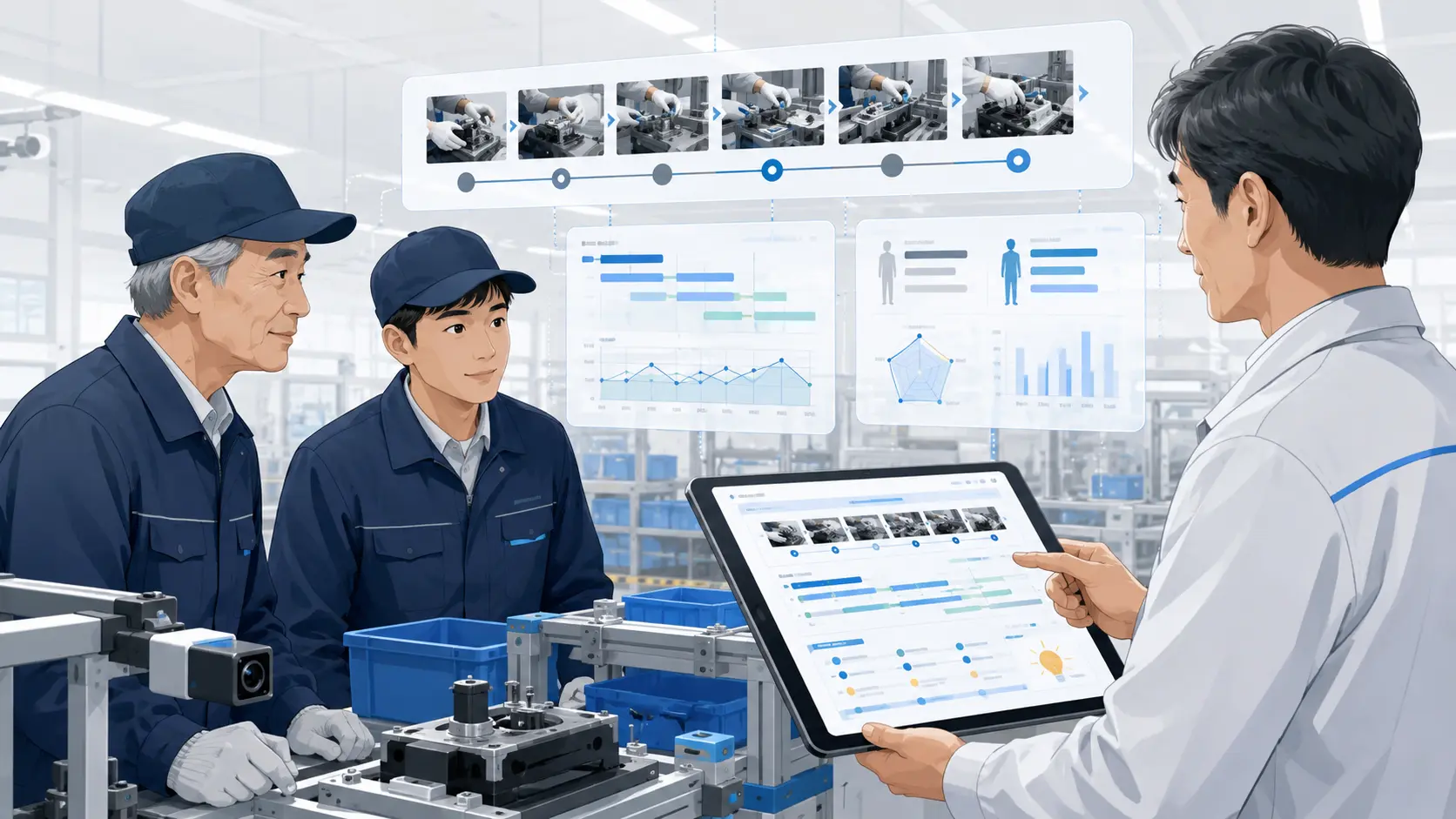
Creating video manuals alone is insufficient for advancing skill transfer in manufacturing. To make it a technique that can be used on the site, the followingFive stepsAre required.
STEP | Content | Goal |
|---|---|---|
1 | Visualizing the veteran's work | Making implicit knowledge visible through video and data |
2 | Identifying work problems and improving them | Eliminating waste and improving work |
3 | Standardizing work as a procedure | Organizing in a form that anyone can reproduce |
4 | Consolidating on the site while comparing with the veteran | Visualizing stumbling blocks and differences to continue improving |
5 | Preventing work errors and stabilizing quality | Maintaining a state where work can be done correctly without errors on the site |
We will look at each one in detail.
STEP 1. Visualizing the veteran's work
The first step in skill transfer is to make the know-how in the veteran's head and body visible through video and data.This is done by recording the veteran's work in video, which allows you to confirm not only the workflow but also hand movements, tool usage, how to hold parts, eye level, and posture. Furthermore, if you can analyze work time, waiting time, movement variability, you can easily grasp "why the veteran is fast" and "where the quality difference appears."In skill transfer, it is important to visualize not only "what is being done" but also "why this work is good."
STEP 2. Identifying work problems and improving them
Simply recording the veteran's work does not necessarily mean it can be standardized as a standard operation. Some long-standing operations may includeWasteful movements, hand waiting, dangerous postures, layout problemsFor example, check the following points:
Not too much movement to retrieve parts
Not too much tool switchingWasteful movements, waiting time, dangerous postures, and layout problems may be included.For example, the following points are checked.
For instance, whether there are many movements to retrieve parts.
Whether there are many tool changes.
Do operators switch their grip on the tool frequently?
Wait time or idle time not occurring
By re-evaluating methods from "I've been doing it this way since long ago" to safe and efficient operations, technical transfer and improvement activities can be advanced simultaneously.
STEP 3. Standardize procedures as standard work
Improved operations must be organized as standard work that is easy to understand for everyone. By establishing work procedures, standard work books, and work manuals, the variability in educational content taught by instructors can be reduced.
At this time, not only paper or Excel work manuals, but alsoCombining videos and images makes it easier to convey fine movements and points of attentionWhen organizing standard work, it is important to clearly define the following information.
Work content of each procedure
Safety precautions
Common mistakes
To transfer technology, tasks that only veterans can perform must be transformed into standard work that can be replicated by workers who have received the necessary education.
STEP 4. Establish the standard in the field by comparing veterans
Creating standard work alone will not establish it in the field.To establish standard work in the field, compare veteran work with work by new and young workers and analyze "where they are stumbling" and "where there is a difference and how much" while continuously improving.This is necessary. Even if a standard work book is handed over and education is provided, it does not guarantee that new or young workers can work exactly as instructed. Comparing with veterans makes it easier to grasp the following "stumbles" or "differences and their causes".
Where the time difference occurs in each process
Whether the work sequence deviates from the standard
Whether there is variation in work time
If these stumbles or differences are not visualized, simply saying "work faster" and "look closely and memorize well" will not establish standard work in the field.
Only by repeating comparison, analysis, and feedback will standard work be established in the field.Only after repeating comparison, analysis, and feedback will standardized work be established in the field.。
While showing the difference with veteran work using data, "let's improve this way."Specific feedback.When data is used to show differences with veterans, it becomes possible to provide specific feedback such as "let's improve this here like this".
STEP 5. Prevent work errors and stabilize quality
The goal of technical transfer is not "learning the work".To create a state where work can be performed smoothly without errors and stably in the field, maintaining quality and productivity. Even after STEP 4 standard work has been established in the field, work errors or procedural omissions may occur.Therefore, the following checks and mechanisms are important.
Are standard work procedures being followed in a different order?
Are necessary check tasks missing?
Are tools and parts being misidentified?
Even if an error occurs, reviewing the cause while watching the video makes it easier to link the consideration of recurrence prevention measures and the revision of standard work.
Even if a mistake occurs, reviewing the cause while watching a video.Technical transfer should be advanced as a system that integrates education, standardization, and quality stabilization, rather than thinking of them separately.How will technical transfer change with the use of AI?
How does technical transfer change with the use of AI?

With Activity Analysis AI, using video and data makes the skill transfer, previously judged by eye and experience, easier.With Activity Analysis AI, using video and data makes it easier to progress.It becomes.
Analyzing work videos with AI enables the following uses.
Key points of AI utilization | What can be done |
|---|---|
Procedure extraction | Automatically extracting procedures from work videos |
Waste detection | Identifying wasteful movements and waiting times |
Creating procedure books and video manuals | Significantly reducing creation burden |
Veteran vs. newcomer comparison | Detailed comparison of work differences |
Error confirmation | Confirming missing procedures and work mistakes |
Traditionally, education officers and field leaders had to watch videos and manually organize procedures or take notes on observations. With AI, work videos can be used not only as "teaching materials" but also as "data for analysis, improvement, and education."This transforms skill transfer from relying solely on personal OJT into a system shared throughout the field.Three points to note when using AI for skill transfer
When using AI for skill transfer, you do not need to introduce it to the entire process at once. By focusing on the following three points, smooth introduction and field adoption can be expected.
Starting with high-educational-load tasks
First,
It is recommended to start with high-educational-load tasks or tasks where quality differences are easily noticeable.
For example, the following tasks are areas where the effectiveness of AI utilization can be easily confirmed.Tasks where veteran and newcomer work time differences are noticeable, tasks where missing procedures or confirmation omissions are easily noticeable, and tasks where paper procedure books are difficult to teach.Paying attention to the "way of conveying" to the field
When introducing AI, the way of conveying to the field is important.
If the purpose of filming work videos is perceived as "monitoring," it becomes difficult to obtain cooperation from the field.
The key is to convey the following:
Preserving the veteran's techniques
Making it easier for newcomers to learnReducing work mistakes。
Not relying solely on AI, but combining it with field judgment
Not relying solely on AI, but combining it with field judgment is also indispensable.
Safety standards, quality standards, internal rules, and the fine details of the work must be confirmed by the person who understands the field.
What is important in AI utilization is not replacing the field's work.
Preserving the field's knowledge, making it easy to convey, and utilizing it for improvement.
Ollo Factory supports the 5 steps of skill transfer in a unified manner.Ollo Factory's Tools enable procedureization, improvement consideration, comparison, and mastery confirmation, while Alerts assist in detecting work mistakes. All are not used at once; you should verify them from features that suit educational challenges.。
Ollo Factory, a manufacturing-specialized work analysis AI, supports these 5 steps in a unified manner.Ollo Factory supports the 5 steps of skill transfer in a unified mannerVisualization | Making veteran work visible through video and data.
Ollo Factory supports the 5-step technical transfer process comprehensively.
Ollo Factory's Tools standardize procedures, review improvements, compare and confirm mastery, and Alerts support detection of work mistakes. Do not assume all must be used at once; verify from features suitable for educational challenges.
Ollo Factory's manufacturing-specialized work analysis AI "Ollo Factory" supports these 5 steps comprehensively.It supports them comprehensively.Ollo Factory supports the 5-step technical transfer process comprehensively.

Visualization | Make veteran work visible through videos and data.
Ollo Factory analyzes work videos to visualize work content and time in the fieldAnalyzing human movement, waiting time, and variability in work makes it easier to grasp, allowing veterans to confirm their work with video and data instead of sensation. It makes it easier to organize "why veterans are fast" and "where quality differences appear".We can do so. It becomes easier to grasp human movement, waiting time, variability in work, etc., allowing veteran work to be confirmed with video and data, not sensation. It becomes easier to organize "why are veterans fast" and "where does quality difference appear".
Improvement | Detecting waste, waiting time, and dangerous work
In technical succession, it is not enough to leave work as it is, but it is important to improve it to a better state and standardize itUsing Ollo Factory makes it easier to find waste in work, waiting time, layout problems, and dangerous work. By finding the trigger for improvement, it becomes easier to advance technical succession and productivity improvement simultaneouslyWe can do so. Using Ollo Factory, it becomes easier to find waste during work, hand waiting, layout problems, dangerous work, etc. By finding the trigger for improvement activities,it becomes easier to simultaneously advance technical inheritance and productivity improvement.。
Standardization | Organizing as a procedure book and video manual
Ollo Factory allows you to organize improved work as a procedure book, standard work book, and video manual. Combining videos and images makes it possible to leave work flows that are difficult to convey with paper and Excel, making it easy to use for new employee education and OJT.Reducing the time required to create a procedure book can reduce the burden on educators and field leaders, and change veterans' work from "watching and learning" to "standard work that anyone can learn easily"Stabilization | Standardizing work in the field through veteran-new employee comparison analysis
Ollo Factory can be used for the purpose of standardizing work in the field by comparing veteran work with work of new and young employees. Through automatic division of elements by AI and synchronized video comparison by element work units, it is possible to visualize work time, work order, variability, and stumbling points.This allows specific feedback to be repeated while showing "where you are stumbling" and "where and how much difference there is" in data instead of sensory guidance. "Teach and finish" can be replaced by repeating comparison, analysis, and improvement to standardize work in the field.Preventing mistakes | Real-time anomaly detection for quality stabilization
Ollo Factory can also be used to confirm movements and work mistakes different from standard work. Early detection of work mistakes and missing procedures supports quality stabilization after education. Real-time anomaly detection can immediately detect missing work such as forgetting to tighten screws, contributing to preventing defective output. When a mistake occurs, reviewing the cause while watching the video makes it easier to link to prevention measures for recurrence and revision of standard work.
Manufacturing industry AI utilization case | Accelerating improvement through veteran-new employee comparisonThe AI-based technical succession introduced so far is already being practiced by major domestic manufacturers. Here, we introduce the representative 3 companies working on veteran-new employee comparison and standard work stabilization using Ollo Factory.It can also be used. AI-based automatic segmentation of elements and comparison of synchronized videos at the element level allows for the visualization ofwork time, work order, variability, stumbling points.
This allows for specific feedback to be repeated while showing, with data, "where you are stumbling" and "where there is a difference and how much" instead of sensory guidance.. "Teach and finish" rather than repeating comparison, analysis, and improvement, allowing the standardized work to be established in the field.Error prevention | Real-time anomaly detection for quality stabilization
Ollo Factory can also be used for confirming standard work and different movements or work mistakes. By linking early detection of work mistakes and missing procedures, it supports quality stabilization after education.
Ollo Factory can also be used for confirming standard work and different movements or work mistakes. By linking early detection of work mistakes and missing procedures, it supports quality stabilization after education.Real-time anomaly detection immediately detects missing work such as forgetting to tighten the screw.Ollo Factory can also be used for confirming standard work and different movements or work mistakes. By linking early detection of work mistakes and missing procedures, it supports quality stabilization after education.Real-time anomaly detection immediately detects missing work such as forgetting to tighten the screw.can also be done and contributes to preventing defective output. Even if a mistake occurs, reviewing the cause while watching the video makes it easier to link recurrence prevention measures and revising standard work.
AI Utilization in Manufacturing: Veteran vs. Newcomer Comparison Accelerates Improvement
So far, we have introducedAI-Powered Technical Transferwhich has already begun in practice at major domestic manufacturers. Here, we introduce the case studies of three representative companies working with Ollo Factory for veteran vs. newcomer comparison analysis and standard work consolidation.comparing experienced and new operators and sustaining standardized work. The next sections describe three manufacturers’ approaches.
Case 1. Nissan Motor Company | Veteran vs. Newcomer Comparison in Finished Vehicle Assembly Process
Nissan Motor Company formally adopted Ollo Factoryin the finished vehicle assembly process. The finished vehicle assembly process involves wide movement ranges—such as workers entering beneath the vehicle or inside it—making the introduction of work analysis software difficult.By analyzing videos captured with wearable cameras using Ollo Factory,
AI-driven automatic segmentation of work elements and synchronized comparison of videos by work unitsbecame possible. This has led to improved learning speed, shortened training time, and enhanced work improvement through veteran-newcomer comparison analysis.Learn more:
Formal introduction of work analysis AI 'Ollo Factory' to Nissan Motor CompanyFormal introduction of work analysis AI 'Ollo Factory' to Nissan Motor Company

Suzuki Corporation formally introduced Ollo Factory
in the assembly workshop of the Aoyama plant in July 2025 and in the engine workshop in December 2025. As part of the Suzuki Smart Factory concept, the domestic factory is positioned as a mother production base,utilizing it for visualization of work variability, skill transfer from veterans, and standardization of work procedures.Automated extraction of work procedures and waste elimination aim to achieve both work efficiency and quality stabilization.Learn more:Suzuki, formal introduction of work analysis AI 'Ollo Factory' to domestic factories
Suzuki, formal introduction of work analysis AI 'Ollo Factory' to domestic factories
Case 3. J-TREC Corporation (Integrated Vehicle Manufacturing) | Proof-of-Concept in Railway Vehicle Manufacturing SiteJ-TREC Corporation (Integrated Vehicle Manufacturing) is conducting a proof-of-concept using Ollo Factory through the JR East Japan Startup Program. In railway vehicle manufacturing sites, processes involving multiple personnel collaboration and critical tasks relying on veteran know-how are common. By using Ollo Factory, the system supports creation of procedural documents from work videos, new worker training, and error prevention, aiming for advancement in vehicle manufacturing technology and productivity improvement.

JR East Japan Group: Launch of proof-of-concept for work analysis AI 'Ollo Factory' in railway vehicle manufacturing sites
JR East Japan Group: Launch of proof-of-concept for work analysis AI 'Ollo Factory' in railway vehicle manufacturing sites
Frequently Asked QuestionsHow do you record decisions not shown in the video?

Can you determine mastery when time differences are minimal?
Time difference alone is insufficient. Mastery is confirmed by verifying work sequence, safety and quality checks, and actions during anomalies—all within defined conditions. If necessary checks are skipped despite faster performance, mastery is not recognized.
What must the two compared videos include?
Can you determine mastery when the time difference is small?
The time difference alone is not sufficient for judgment. The conditions include work sequence, safety and quality verification, and behavior during anomalies. If necessary verification is skipped and speed increases, it is not considered mastery.
What do the two compared videos represent?
Gather product number, equipment/tools, component supply, measurement area, and required checks. Record differences if conditions vary, and do not treat all time differences as skill differences.
Summary: Link video differences to instruction, and verify the ability to replicate the target task.
Use approved tasks and decision criteria as materials, and learn unshown tips from the video to supplement.
Compare videos with the same product number/conditions, and link differences to specific instruction.
Verify the ability to replicate the task under required conditions, and revise materials and evaluation when the process changes.
Use AI to automate step extraction, element-by-element comparison, and time difference organization. Confirm whether skill has been inherited by having the responsible person verify necessary judgment/work. Detecting work errors is one method to maintain quality after stabilization.
The manufacturing-specialized work analysis AI "Ollo Factory" can automate video comparison and educational material creation.
Ollo Factory supports step-by-step structuring of tasks, element-by-element comparison, and visualization of time variability. Define educational use cases and target processes, starting with actual video confirmation.

Watch Ollo Factory’s Video Manual AI in Action
About the author
K.Y. | Business Development Lead & Marketing, Ollo Inc.
K.Y. leads business development and marketing at Ollo Inc., an AI startup originating from the Matsuo Laboratory at the University of Tokyo and the developer of Ollo Factory, a work analysis AI for manufacturing.
After studying engineering and design at university, K.Y. joined a major automaker and worked on new electric-vehicle development, from design through factory production, including hands-on assembly-line training. K.Y. later worked in sales and marketing at a manufacturing startup.
Today, K.Y. helps manufacturing teams use AI to improve the way they work through Ollo Factory.
Back to articles
Related articles
See how Ollo Factory can support your factory
Book a demo
• See the product in action
• Discuss your production needs
• Explore available plans
Book a demo

Request a brochure
• Customer stories
• Key features
• How to get started
