

Published:
Lean Improvement
How to Reduce Setup and Changeover Time in Manufacturing

Internal setup improvement: re-evaluate preparation, exchange, adjustment, and confirmation methods to reduce production stops when switching product types; distinguish internal setup (requires equipment shutdown) from external setup (can be done safely during operation).
This article uses an automotive component unit assembly example to explain classification, time measurement, external setup, and effectiveness verification; reduce production interruptions while confirming human labor and first-piece quality.
- Internal vs. External Setup Differences
- 1. Define setup time start and end points
- 2. Photograph and record the entire process, then categorize elements
- 3. Selecting tasks to transition to outer segment
- 4. Revising the remaining inner segment tasks while maintaining confirmation
- 5. Confirming the changeover results using four indicators
- Measures for when the changeover again takes longer after improvement
- Frequently asked questions
- Does increasing outer segmentization always increase productivity?
- Do you record the waiting time for initial product confirmation?
- Summary: Review work during stops and evaluate both time and labor.
- "Ollo Factory", a manufacturing-specific work analysis AI that automates classification of setup work, time aggregation, and creation of improvement proposals.
- ① Organize the entire changeover into elements.
- ② Consider candidates for external setup and method change.
- Watch Ollo Factory’s Improvement Suggestions AI in Action
Internal vs. External Setup Differences
Classification | Meaning | Example for Assembly Consideration |
|---|---|---|
Internal Setup | Setup requiring equipment shutdown | Shutdown requiring tool/fixture exchange, setting change, and confirmation |
External Setup | Setup that can be conducted during operation in a separate safe location and conditions | Preparation for next tool/fixture/approved documentation |
Classification is not based on whether the equipment is outside the facility; do not classify activities entering the equipment’s operational range or unsafe confirmations as external setup for time reduction.
J-Net21 Small Enterprise Foundation Institution: "Waste-Free Setup Improvement Methods"The procedure introduces identifying setup content, dividing into external setup, internal setup, and waste activities; first record preparation during shutdown, then seek items that can be safely completed during production.
1. Define setup time start and end points
Evaluate the entire changeover process by using the boundary from "last good piece of previous variety" to "first good piece of next variety"; record which steps include equipment shutdown, fixture exchange, condition confirmation, trial run, and first-piece verification.
Using only the "fixture exchange completion point" as the end point obscures subsequent adjustments and defects; compare improvement before and after using the same boundary, including waiting and approval steps.
2. Photograph and record the entire process, then categorize elements
In setup recording, divide the following aspects:
Work Content:Fixture transport, tool search, removal/installation, setting, first-piece verification
Equipment State:Whether equipment is stopped or operating between each task
Human Labor:Individual worker time and sections done simultaneously by multiple workers
The following is a model for unit assembly where fixtures/specifications are switched sequentially; one worker performs tasks in sequence, with all tasks completed sequentially after previous variety’s production ends; first-piece verification includes trial run, prototype production, and judgment.
Elements: | Changeover time | Classification & Review |
|---|---|---|
Transport next fixture | 4 minutes | Can safely prepare in a separate location ahead of time? |
Search/gather tools | 3 minutes | Can be standardized and prepared before shutdown? |
Replace fixture | 6 minutes | Internal setup: follow required shutdown and safety procedures |
Set to approved conditions | 3 minutes | Internal setup: do not omit matching |
First-piece production/verification | 4 minutes | Post-changeover trial run/production/judgment: confirm safe operating conditions and restart conditions |
Total | 20 minutes | Distinguishing stop and human labor |
3. Selecting tasks to transition to outer segment
Assuming that the transport of fixtures (4 minutes) and tool preparation (3 minutes) can be safely completed during the production of the previous variety. If these preparations are completed before the changeover starts, the production interruption time of this model is shortened from 20 minutes to 13 minutes.
Outer segmentization is an improvement that does not eliminate tasks but shifts the execution point. The preparation work remains, so it is confirmed whether the monitoring of normal operation and preparation can be carried out by the same person, and whether it does not affect safety, quality, or performance. If a different person performs the preparation, their labor and handover are recorded. Evaluate not only the stop time but also the labor time of the task and its impact on other processes.
4. Revising the remaining inner segment tasks while maintaining confirmation
Remaining tasks that cannot transition to the outer segment are revised while maintaining the necessary confirmation. Investigate access to tools and fastening points, fixture positioning, method of condition matching, and consider dedicated identification and guides, and the standardization of preparation items. If equipment modification or change in fixation method is required, confirm with the technical, safety, and quality responsible person before proceeding.
Do not omit the safety procedures for initial product confirmation, calibration, stop, and recovery for time reduction. If the method of confirmation is changed, grounds and approval are required to meet equivalent or higher objectives.
5. Confirming the changeover results using four indicators
Indicators | Meaning of confirmation |
|---|---|
Production interruption time due to segment transition | Measuring from the last good product of the previous variety to the first good product of the next variety. The stop time of the equipment itself is recorded separately. |
Human labor | Including preparation, transport, and confirmation, also observe the time of other personnel. |
Initial product and quality after changeover | Is there an increase in confirmation omissions, incorrect settings, and rework? |
Workload and safety conditions | Is there an increase in simultaneous work or excessive movements? |
Record the trial changeover patterns, varieties, and number of people. Avoid mixing similar varieties with short segments and segments with significantly different conditions.
To reduce the effort of aggregating and comparing times by creating a video of the segment and dividing it by task, AI analysis can be utilized.
Measures for when the changeover again takes longer after improvement
Identify causes such as insufficient preparation, shared placement of fixtures, non-return of tools, and incomplete confirmation of preparation by the standard. Document the preparation personnel, start timing, required items, and completion confirmation. Also, define the response for cases where preparation is not completed before the stop.
The time for parallel operations is not a simple sum of each element but is read based on the time axis until the process can resume. Confirm whether simultaneous tasks involve human interference or conflict.
Frequently asked questions
Does increasing outer segmentization always increase productivity?
While the possibility of shorter stops exists, there are constraints on personnel, location, and labor for preparation. Confirm that quality, safety, and impact on other processes are all met.
Do you record the waiting time for initial product confirmation?
If it occurs within the predetermined restart boundary, record the waiting time. Do not delete the confirmation work; instead, consider improving the notification to the approval holder or the preparation system.
Summary: Review work during stops and evaluate both time and labor.
Define the start and end points of the changeover, separate internal and external setups, and record them.
Find tasks that can be safely prepared during operation and tasks where the method can be changed.
Compare stop time, operator time, and first-piece quality under the same conditions.
The division of the setup video, time aggregation, and organization of improvement candidates can be automated by AI. While aligning with on-site safety conditions, consider external setup, tool and layout changes.
"Ollo Factory", a manufacturing-specific work analysis AI that automates classification of setup work, time aggregation, and creation of improvement proposals.
① Organize the entire changeover into elements.
Organize the time for each segment from the work video, confirming how long preparation, tool exchange, condition setting, and first-piece confirmation take. Determine the start and end points of production interruption, separating equipment status and human work time for improvement consideration.

Official demo screen of Ollo Factory. This is a different task from the unit assembly example in the text.
② Consider candidates for external setup and method change.
The video presents problems and improvement proposals. It can be used as material to confirm stop-time search and preparation, and to consider tasks that can be safely transferred during operation or those to be left for confirmation.
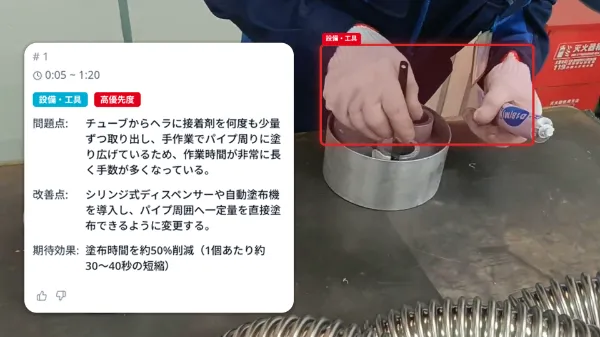
Official demo screen of Ollo Factory. This is a different task from the unit assembly example in the text.
Equipment stop and safety conditions cannot be definitively determined from video alone. The personnel, time, first-piece confirmation, and interference for external setup work must be verified on-site.
Watch Ollo Factory’s Improvement Suggestions AI in Action
About the author
K.Y. | Business Development Lead & Marketing, Ollo Inc.
K.Y. leads business development and marketing at Ollo Inc., an AI startup originating from the Matsuo Laboratory at the University of Tokyo and the developer of Ollo Factory, a work analysis AI for manufacturing.
After studying engineering and design at university, K.Y. joined a major automaker and worked on new electric-vehicle development, from design through factory production, including hands-on assembly-line training. K.Y. later worked in sales and marketing at a manufacturing startup.
Today, K.Y. helps manufacturing teams use AI to improve the way they work through Ollo Factory.
Back to articles
Related articles
See how Ollo Factory can support your factory
Book a demo
• See the product in action
• Discuss your production needs
• Explore available plans
Book a demo

Request a brochure
• Customer stories
• Key features
• How to get started
