

Published:
Manufacturing DX
What Is Physical AI? How It Works and Where Manufacturers Use It

Physical AI is a technology that captures the real-world situation with cameras and sensors and connects AI decision-making to robot or machine actions. It is characterized by generating text or images as well as performing physical tasks such as "grabbing parts" and "moving objects."
In manufacturing, the use of Physical AI is expected for the retrieval of parts whose placement varies each time and collaborative assembly work with humans. However, embedding AI in robots does not allow them to perform any task.
This article explains the mechanism of Physical AI, its differences from generative AI and conventional robots, factory applications, and challenges for practical implementation. It also organizes what to check when considering introduction in the field.
- What is Physical AI? AI that recognizes, judges, and acts in the real world
- Difference from robots in the relationship between "machine" and "intelligence"
- How Physical AI operates
- Learning uses real machine data and simulations.
- Difference between generative AI and physical AI
- Why is physical AI gaining attention now?
- AI and learning techniques for robots that combine multiple pieces of information have advanced. In the factory, there are situations where multiple pieces of information such as images, positions, and forces are combined to make judgments. The advancement of "multimodal AI" that combines image, language, and sensor information supports such judgments.
- Factories face labor shortages and need automation that can adapt to changing conditions.
- Examples of Physical AI utilization in manufacturing
- 1. Retrieving parts with varying positions and orientations.
- 2. Adjusting assembly operations based on part state.
- 3. Dividing tasks according to human burden.
- Remaining challenges with Physical AI practicalization
- Can it operate under different conditions from learning?
- Can it address risks associated with human and equipment contact?
- We assess whether the system delivers results including post-deployment adjustments and maintenance.
- Three key checks when considering factory deployment.
- Common questions about Physical AI
- Is Physical AI a humanoid robot?
- Are all factory robots Physical AI?
- Can we teach robots by recording human work videos?
- Summary: Physical AI is the technology linking AI decisions to real-world actions.
- How to analyze and digitize robot movements from videos
- Watch Ollo Factory’s Work Analysis in Action
What is Physical AI? AI that recognizes, judges, and acts in the real world
For example, if a part with an uneven orientation is inside a box, the robot finds the part's position, determines where to grab it, and actually retrieves it. Choosing physical actions based on the surrounding state is the basic concept of Physical AI.
The target is not limited to humanoid robots. Various types of machines such as robot arms and autonomous mobile robots are used.Explanation by the Industrial Technology Comprehensive Research InstituteHowever, Physical AI is described as AI that acts in the real world.
Difference from robots in the relationship between "machine" and "intelligence"
Robots are machines that move arms or move. Physical AI is responsible for the intelligence that makes the machine recognize the surroundings and act according to the situation.
Conventional factory robots also perform sensor-based correction and complex control. Physical AI particularly emphasizes the ability to respond to changes in objects and the environment using learned information.
However, it is not possible to clearly divide "conventional robots" and "Physical AI." It is important to check which state changes can be responded to and how much re-setting is required when changing the task, rather than the name.
How Physical AI operates
The basic isRecognize → Judge → Act → Confirm resultsThis is organized using the example of unit assembly of automobile parts where the housing is loaded onto the fixture.
Stage | What AI and machines do | Example of unit assembly |
|---|---|---|
Recognition | Capture the target and surroundings with cameras and sensors | Confirm the position, orientation, and state of the fixture |
Judgment | Choose actions that meet the purpose and constraints | Determine the grabbing position and the non-collision path |
Action | Move the robot arm or hand | Lift the part and align it with the fixture |
Confirm results | Confirm the state after action | Confirm that the part is correctly loaded and proceed to the next action |
Some tasks require more than visible information. For example, in the pushing of parts, contact force information is sometimes needed in addition to the position shown in the video. The required sensors vary depending on the parts and tasks.
Note that verifying the operation results is different from retraining the AI model on the spot. It is sometimes designed to separate learning, verification, and operation during production rather than allowing free learning.
Learning uses real machine data and simulations.
Methods for teaching robots to perform tasks include imitation learning, which draws on human demonstrations, and reinforcement learning, which learns actions based on trial and error results. Simulations in virtual space are also used.
However, friction, lighting, and individual differences in parts differ between virtual space and the actual factory. Even if a motion succeeds in simulation, it must be confirmed whether it will occur the same way in the real machine.
Difference between generative AI and physical AI
Generative AI focuses on "creating information"; Physical AI focuses on "operating in the real world"Generative AI generates text, images, audio, etc. Physical AI handles objects through robots or machines and interacts with the environment.
Point of comparison | Generative AI | Physical AI |
|---|---|---|
Main outputs | Text, images, audio, programs, etc. | Physical actions by robots and machines |
Application examples in manufacturing | Answering inquiries, drafting documents | Retrieving parts, transporting, assembling |
Result confirmation | Accuracy of content and compliance with instructions | Success or failure of the task, quality, speed, contact, etc. |
The two are not conflicting technologies. The language understanding and action generation of generative AI can be incorporated into the mechanism by which robots understand instructions.
On the other hand, even if a command like "put the part back in the box" is understood, it does not necessarily mean the part can be held without dropping. Word understanding and the ability of the machine to move safely and reliably require separate verification.
Why is physical AI gaining attention now?
AI and learning techniques for robots that combine multiple pieces of information have advanced. In the factory, there are situations where multiple pieces of information such as images, positions, and forces are combined to make judgments. The advancement of "multimodal AI" that combines image, language, and sensor information supports such judgments.
Furthermore, research is underway on "robot base models" that learn data from various tasks and apply them to other tasks. This may reduce the burden of development and adjustment for each task, leading to increased interest in physical AI.
NEDO robot explanationThen, the directions of these technologies and research development are introduced.In the factory, labor shortages and the need for automation that can adapt to change are challenges.
Factories face labor shortages and need automation that can adapt to changing conditions.
Processes that can be automated by supplying the same part to the same position are easier to meet automation conditions. On the other hand, in processes involving multiple varieties, adjustments to part numbers, shapes, and supply methods may be necessary whenever the shape or number changes.
Expected from Physical AI: handling such changes. It is worthwhile to consider in the field, mainly the following challenges.
Parts position and orientation do not remain constant, requiring human labor for retrieval.
Heavy parts remain, involving significant physical strain.
Frequent species changes, requiring time for reconfiguring automated equipment.
In Japan, NEDOis conducting research and development on domestic AI models as the foundation for Physical AI development.However, it is necessary to distinguish between ongoing research and development and practical implementation in all factories.
Examples of Physical AI utilization in manufacturing
1. Retrieving parts with varying positions and orientations.
Purpose: recognizing parts in a box, determining where to grasp them and the order of retrieval. In unit assembly, retrieving the housing from the part box and supplying it to the fixture is a possible scenario.
When introducing, verify not only the retrieval success rate but also whether the system can operate even with overlapping parts, shine, oil adhesion, and the residual state on the box bottom. It is important that the parts are not damaged and that they can be supplied to the next stage within the required time.
2. Adjusting assembly operations based on part state.
Purpose: aligning parts or adjusting operation based on contact state. In unit assembly, cover alignment and connector insertion are considered targets.
However, appearing as if parts are inserted is different from meeting quality standards. Dimensions, insertion depth, tightening results, and quality data required in the process are combined to determine success. The tasks listed here are examples of applications, and not all tasks can be automated with the same difficulty.
3. Dividing tasks according to human burden.
Physical AI utilization does not necessarily replace all human labor. It is also possible to have robots handle heavy tasks while humans take on judgment and fine-tuning tasks.
Joint research by SATO-KEN and Toyota Motor CorporationDemonstration. In this demonstration, robots assist in part supply considering the physical load of operators, verifying the balance of productivity and burden reduction. This is the result of a pilot experiment, and it does not necessarily mean the same effect is achieved in all production lines.tested a robot that supplied parts with the operator’s physical workload in mind. The team examined both productivity and workload reduction in a demonstration. The outcome will depend on the conditions of each production line.
Remaining challenges with Physical AI practicalization
Can it operate under different conditions from learning?
Success with learned parts does not guarantee success with similar-shaped different part numbers or lighting changes. Specifically verify the conditions that can be used, such as part number, part placement, lighting, and speed.
Successive videos alone cannot grasp how failures occur. Verify scenarios such as mis-grasping, part snagging, supply failure, and how the system stops and recovers in each state.
Can it address risks associated with human and equipment contact?
Physical AI decisions manifest as real machine movements. Recognition errors may lead to part drops or human contact.
We evaluate not only AI recognition accuracy but also operational range, speed, stopping methods, and human involvement scenarios. We also confirm which devices handle safety functions with robot manufacturers and system integrators.
We assess whether the system delivers results including post-deployment adjustments and maintenance.
Deployment costs include robot bodies, AI, hands, sensors, fixtures, peripheral equipment connections, and validation. We also consider who adjusts after adding new parts and who restores operation upon shutdown.
Beyond demo success rates, we measure continuous operation processing time, rework, stopping, and restart counts to determine if the system can be sustained in the factory.
Three key checks when considering factory deployment.
It is more effective to define the problematic tasks and desired conditions first rather than starting with "integrating Physical AI." For example, for unit assembly, we focus on "automating housing supply and reducing worker lifting burden."
Target tasks and variable conditions:Scope of operations: what, from where to where, and how much the part number, placement, and lighting may vary.
Acceptance criteria:How to measure quality, processing time, and success rates; how to halt during anomalies.
Operation and cost:Who handles part additions, maintenance, and restoration; whether peripheral equipment costs justify the investment.
Use these conditions for small-scale validation, involving production technology, manufacturing, quality, and safety specialists to verify results. It is crucial to evaluate not just AI performance but the entire process's feasibility.
Common questions about Physical AI
Is Physical AI a humanoid robot?
Humanoid robots are one application. Robotic arms handling parts and autonomous moving machines also fall under scope. The term emphasizes the mechanism of perceiving the real world and adapting to its conditions, rather than appearance.
Are all factory robots Physical AI?
Being robotic does not guarantee AI use. We distinguish between programmed execution mechanisms and decision-making mechanisms based on learned information.
Can we teach robots by recording human work videos?
Videos can be a learning resource, but recording alone does not guarantee task reproduction. The robot's structure and learning methods may require positional, force, and motion command data or additional demonstrations.
Summary: Physical AI is the technology linking AI decisions to real-world actions.
Physical AI recognizes, judges, and drives robots or machines in real-world situations. In manufacturing, it is expected to be used for part retrieval, assembly, and human task division.
The difference from generative AI lies in handling physical actions alongside information generation.
Applicable to more than humanoid robots, including robotic arms and autonomous moving machines.
For deployment decisions, we must assess adaptability to change and balance quality, safety, and operational costs.
The key is not to choose only by the name of the technology, but to confirm whether the required work in the target process continues to be completed. Separating expected applications and proven scopes makes it easier to consider suitable utilization methods in the field.
How to analyze and digitize robot movements from videos
If you want to grasp robot operations, you can also analyze work videos. Ollo Factory'sOllo Factory's operation analysis AIYou can classify robot videos into "pickup", "transport", "installation", "stop" and digitize the time and proportion for each operation.

Ollo Factory's screen visualizing the time by classifying robot operations and visualizing the time. It is used to organize actions that can be confirmed from videos.
In videos where people and equipment are shown together, you can also check the relationship between each action and waiting time. Comparing movements before and after process changes and investigating which section has a time difference becomes a material.
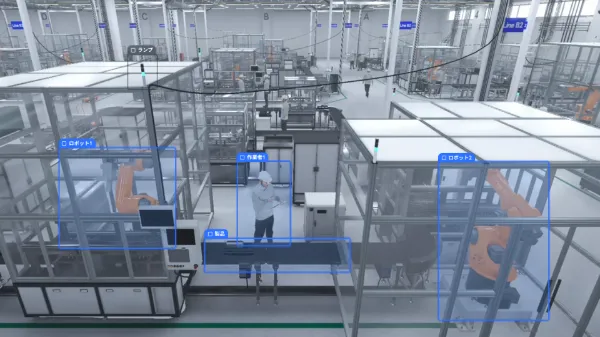
Ollo Factory's official demo screen. An example of checking the operation status of workers and equipment in the factory.
This is a function for observing and analyzing robot movements, which is different from the function for issuing or controlling robot actions.
Watch Ollo Factory’s Work Analysis in Action
About the author
K.Y. | Business Development Lead & Marketing, Ollo Inc.
K.Y. leads business development and marketing at Ollo Inc., an AI startup originating from the Matsuo Laboratory at the University of Tokyo and the developer of Ollo Factory, a work analysis AI for manufacturing.
After studying engineering and design at university, K.Y. joined a major automaker and worked on new electric-vehicle development, from design through factory production, including hands-on assembly-line training. K.Y. later worked in sales and marketing at a manufacturing startup.
Today, K.Y. helps manufacturing teams use AI to improve the way they work through Ollo Factory.
Back to articles
Related articles
See how Ollo Factory can support your factory
Book a demo
• See the product in action
• Discuss your production needs
• Explore available plans
Book a demo

Request a brochure
• Customer stories
• Key features
• How to get started
