

Published:
Lean Improvement
How to Use the 5 Whys in Manufacturing

The same defects keep happening, but countermeasures stop at "warning" or "re-educating." Root cause analysis is a method for systematically examining the background of an incident and connecting it to a system that prevents recurrence.
However, simply writing "why" five times won't reveal the cause. This article uses the assembly of automotive parts as an example to explain the procedure for separating facts from hypotheses to verify the cause and then using that information to develop countermeasures and verify their effectiveness.
- What is a "why-why" analysis? It's about confirming causal relationships rather than relying on the number of occurrences.
- How to conduct a root cause analysis
- 1. Focus on one phenomenon to analyze.
- 2. Gather the facts before and after the fact before asking "why".
- 3. When there are multiple reasons, branch them out.
- 4. Correspond the causes and countermeasures, and verify their effectiveness.
- Example of a Root Cause Analysis for Unit Assembly
- Three patterns where the "why-why" analysis becomes merely a formality.
- FAQ
- How many times should I ask "why"?
- How do you differentiate between using a cause-and-effect diagram and a cause-and-effect diagram?
- Summary: Why-Why analysis leaves both the question and the evidence together.
- Ollo Factory: An AI-powered work analysis tool that supports root cause investigation and standardization after improvement.
- Investigate potential causes
- Supporting standardization after improvements
- Watch Ollo Factory’s Improvement Suggestions AI in Action
What is a "why-why" analysis? It's about confirming causal relationships rather than relying on the number of occurrences.
The "why-why analysis" is a technique for repeatedly asking "why did this happen?" in response to a specific problem, and delving into the root cause. It is also used when differentiating between temporary fixes, such as replacing parts, and measures to prevent the same failure from occurring again.
The goal of the analysis is not to answer the five whys. It is to be able to explain how events occur with evidence, identify conditions that can be changed on-site, and clarify how to verify those countermeasures. If there are multiple reasons, branch them out, and return to check anything that remains unclear.
Even if we determine that the person in charge failed to check, that alone is not enough to prevent recurrence. We also need to investigate whether the items to be checked were visible, whether criteria were established, and whether there were any interruptions or disruptions to the work.
How to conduct a root cause analysis
1. Focus on one phenomenon to analyze.
First, describe what should have happened under normal circumstances and what was actually different. Broad problems like "poor assembly quality" are difficult to pinpoint directly, so narrow them down to the part number, process, and phenomenon.
Target: Housing fastening process for Unit A
Desired state: All designated connections have been secured.
What happened: During the final inspection, it was discovered that one bolt was not properly fastened.
If hazardous or defective products continue to leak, take emergency measures such as stopping, isolating, and contacting relevant parties before analysis. Do not release the defective products or attempt to recreate the hazardous conditions in order to determine the cause.
2. Gather the facts before and after the fact before asking "why".
We will examine the actual items, drawings, work records, tool logs, and work videos, and interview those involved to understand the situation. Since the scope of information varies depending on the source, it is important not to draw conclusions based on a single testimony or video.
For example, even if the tightening sequence is skipped in the video, it may not be possible to determine when the torque is achieved. We will match the actions observed in the video with the results confirmed by the tool itself.
Before moving on to the next question, confirm whether the answer to the previous question is a fact or still a hypothesis. If it's a hypothesis, decide what you need to look at to verify it.
3. When there are multiple reasons, branch them out.
A single event can be influenced by a combination of factors, including work methods, equipment, materials, and labeling. Connecting only the first reason that comes to mind can lead to overlooking other contributing factors.
The reasons for the lack of agreement and the reasons for proceeding to the next process without an agreement are separate questions. The former may relate to interruptions, resumptions, or work order, while the latter may relate to completion confirmation or flow conditions. We will investigate both the occurrence and the outflow aspects.
4. Correspond the causes and countermeasures, and verify their effectiveness.
Based on the identified causes, we will decide which conditions to change and how. We will also determine the person responsible, the deadline, and what criteria will be used to define the changes as effective.
For example, if we add a display indicating the restart location, we verify that anyone can use the display to resume work in situations that involve interruptions. We also record the production quantity and affected part numbers after implementing the countermeasures to confirm that the absence of errors was not merely a matter of luck.
Example of a Root Cause Analysis for Unit Assembly
The following is a hypothetical example of how to think about why one bolt was not fastened during unit assembly. Not all answers represent actual causes or manufacturing conditions. Proceed to the next "why" only after confirming the previous answer. In actual analysis, do not limit yourself to five steps, but delve deeper until you can confirm the cause-and-effect relationship and countermeasures.
question | Possible factors | Evidence and methods for verification |
|---|---|---|
Why was one bolt not fastened? | It's possible that the location was skipped when work resumed after the interruption. | Compare the video footage from before and after the interruption, the tool log, and the actual item. |
Why did they skip that location when resuming? | Possible misidentification of the location where the contract was already signed. | We will ask the workers about their understanding of the situation when the work was resumed and compare it with the video footage. |
Why did they mistakenly identify the location where the contract had already been signed? | There was no mechanism to record or display the interruption point, which may have made it difficult to determine the resumed position. | Review the procedure manual and on-site signage, and inquire about procedures for interruption and resumption. |
Why wasn't there a system to record and display the interruption point? | The procedure manual may not have specified how to record the interruption point or how to verify it when resuming. | Check the procedure manual and the recording methods used on site. |
Why wasn't there a procedure manual that specified how to interrupt and resume operations? | It's possible that the work status, including interruptions and resumptions, was not considered when creating the procedure. | Review the records of the creation and revision of the procedure manuals and ask relevant parties about the considerations made during their creation. |
You shouldn't jump to conclusions about the cause before confirming it. The lack of a label and the fact that a misunderstanding occurred are separate issues. Depending on the results of the investigation, it may be necessary to look into parts supply and tool handling.
Furthermore, it's not always necessary to narrow down a problem involving multiple contributing factors to a single cause. We will document the factors necessary to prevent recurrence, along with the supporting evidence.
When comparing work videos to verify facts or preparing procedure manuals after corrective measures have been taken, you can also utilize AI for work analysis.
Three patterns where the "why-why" analysis becomes merely a formality.
This leads to assigning blame: Blaming someone by asking "Why couldn't you do it?" doesn't capture the conditions at the scene. Instead, ask specifically about the actions and the environment.
Work backward from the desired solution: List the causes that are favorable for the equipment or training you want to implement. Also, check for information that contradicts this.
Writing a clean copy without verification: Even if the explanation seems to connect, a hypothesis doesn't automatically become a fact. Leave unconfirmed points and methods for verification.
The Ministry of Health, Labour and Welfare's accident cases at manufacturing facilities highlight multiple factors, including safety devices, operating positions, procedures for non-routine tasks, and training. It is important not to limit the problem to human behavior alone, but to also examine the equipment and work processes.
FAQ
How many times should I ask "why"?
The judgment will not be based on the number of occurrences, but on whether the cause and effect can be verified and feasible preventative measures can be examined. There is no need to add unsubstantiated reasons or abstract management issues just to reach five occurrences.
How do you differentiate between using a cause-and-effect diagram and a cause-and-effect diagram?
A cause-and-effect diagram is useful when you want to broadly organize possible factors. For a more in-depth look at how a specific event occurred, a root cause analysis can be used. Both methods require a step to verify whether the listed factors are truly related.
Summary: Why-Why analysis leaves both the question and the evidence together.
Starting with a single specific event, we distinguish between facts and hypotheses.
Investigate the occurrence and leakage, and examine the multiple reasons by branching them out.
We will match the identified causes with the countermeasures and verify their effectiveness in actual work.
To alleviate the burden of repeatedly checking the before and after of a task, you can utilize video analysis AI. By using the differences pointed out by the AI as clues, you can verify the cause with the actual object and records, making it easier to gather information for the investigation.
Ollo Factory: An AI-powered work analysis tool that supports root cause investigation and standardization after improvement.
Ollo Factory is an AI-powered work analysis tool specifically designed for the manufacturing industry. It supports AI-based classification of work videos and comparison of work examples with target work examples.
By utilizing AI-powered improvement suggestion and AI-powered video manuals , we support everything from investigating the root cause in root cause analysis to standardizing improvements after implementation.
Investigate potential causes
The AI improvement suggestion tool extracts potential problems from work videos and automatically presents improvement proposals. You can review the video to identify potentially omitted steps or time-consuming operations, and use this information for root cause analysis.
Furthermore, it can be used to review the work video after the improvements have been made and to check if any other problems have arisen.
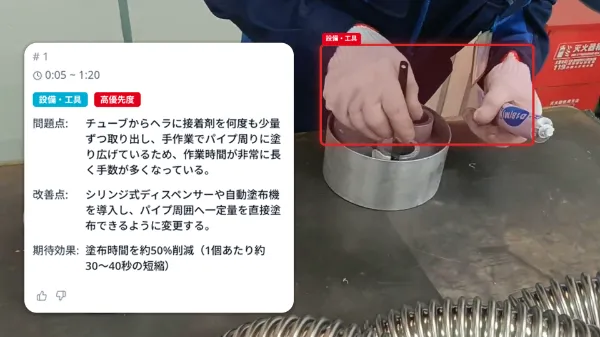 This is a demo screen from the official Ollo website. It does not represent the result of analyzing the process described in the main text.
Supporting standardization after improvements
The AI-powered video manual system automatically divides uploaded work videos into steps and generates task names and descriptions. The improved work processes can then be compiled into manuals, leading to standardization and training.
 This is a demo screen from the official Ollo website. It does not represent the result of analyzing the process described in the main text.
If you'd like to proceed from video-based root cause analysis to standardization after improvements, please refer to the Ollo Factory documentation.
Request information from Ollo Factory.
Watch Ollo Factory’s Improvement Suggestions AI in Action
About the author
K.Y. | Business Development Lead & Marketing, Ollo Inc.
K.Y. leads business development and marketing at Ollo Inc., an AI startup originating from the Matsuo Laboratory at the University of Tokyo and the developer of Ollo Factory, a work analysis AI for manufacturing.
After studying engineering and design at university, K.Y. joined a major automaker and worked on new electric-vehicle development, from design through factory production, including hands-on assembly-line training. K.Y. later worked in sales and marketing at a manufacturing startup.
Today, K.Y. helps manufacturing teams use AI to improve the way they work through Ollo Factory.
Back to articles
Related articles
See how Ollo Factory can support your factory
Book a demo
• See the product in action
• Discuss your production needs
• Explore available plans
Book a demo

Request a brochure
• Customer stories
• Key features
• How to get started
