

Published:
Lean Improvement
How to Implement 5S in a Factory and Sustain the Results

Factory 5S activities are efforts to use necessary items without delay, detect abnormalities, and maintain a good state through sorting, tidying, cleaning, cleanliness, and discipline. Tracking only the frequency of notices and cleaning sessions may leave challenges such as searching for tools or misplacing items in the field.
To sustain the activity, it is important to define the problem to be improved, the normal state, the responsible person, and the confirmation method. This article explains the 5S approach and checks to prevent routinization using the example of automobile parts unit assembly.
- What is Factory 5S? Linking the five meanings to the work.
- How to proceed with 5S
- 1. Start with one location and one challenge
- 2. In sorting, do not leave items that cause confusion
- 3. In tidying, align the flow of using, returning, and replenishing
- 4. Use cleaning as an opportunity to verify condition.
- 5. Establish a sustainable system for cleanliness and order.
- Three re-evaluation points to prevent rigidity.
- Prioritize reduction in issues over score.
- Investigate root cause of recurring feedback.
- Avoid excessive increase in check items.
- Summary: Define normal state and sustaining system.
- "Ollo Factory" – a manufacturing-specialized work analysis AI that automates action analysis and time aggregation for 5S.
- Verify 5S challenges using actual operation and time data.
- Watch Ollo Factory’s Improvement Suggestions AI in Action
What is Factory 5S? Linking the five meanings to the work.
Applying the five 5S activities to the unit assembly workbench results in the following: Performing 5S increases safety, improves efficiency, and connects to employee education.
5S | Meaning | Unit assembly example |
|---|---|---|
Sorting | Separate necessary from unnecessary items and determine handling methods. | Distinguish unused tools and outdated procedures. |
Set in order | Determine placement, method, and quantity, and ensure necessary items can be retrieved and returned. | Define the fixed position and identification for tools and parts. |
Cleaning | Remove dirt and confirm the condition of equipment and locations. | Confirm foreign objects and oil leaks around tools. |
Standardize | Continuously sort, tidy, clean, and maintain a good state by creating a system. | Define standard photos, supply, and cleaning timing. |
Sustain | Understand the rules and procedures set, and continue to follow them in daily work. | Educate and confirm return, abnormal reporting. |
5S Explanation from Small and Medium-Sized Manufacturing J-Net21The article describes initiatives tied to field challenges such as searching and dirt, beyond visual scores—check if actual work has become easier.
How to proceed with 5S
1. Start with one location and one challenge
For the unit assembly closing workbench, begin with the following challenges:
Tool search: Do tools go missing at start and end of shift?
Part mixing: Are different parts mixed in the same box or place?
Tool foreign objects: Do residual foreign objects hinder assembly or confirmation?
Start with one location, define the flow for determining normal state and correcting abnormalities.
Define observation indicators such as tool search frequency, time, number of misplacements, and rework due to tool foreign objects. Limit data collection burden by narrowing the scope.
2. In sorting, do not leave items that cause confusion
Separate in use, reserve, unconfirmed, and discard candidates, and set deadlines with the decision-maker. Do not discard reserve equipment or measuring tools simply because they are "not used recently." Confirm usage plans, quality and maintenance roles, and storage rules to determine handling.
Outdated work procedures should be made unusable in the field while preserving necessary history in document management rules. Sorting is not an activity to compete on waste volume.
3. In tidying, align the flow of using, returning, and replenishing
Tools are placed based on usage frequency, order, accessibility, recognizing shape and labels, identifying missing parts, distinguishing alternative tools, and defining return condition. Component box includes part number, storage location, replenishment method to prevent misplacement of similar parts.
Before changing layout, verify equipment range, pathways, and ease of quality check. Even with shorter movement, monitor for non-optimal posture or increased oversight gaps.
4. Use cleaning as an opportunity to verify condition.
Define where, when, with what, and which state constitutes abnormality. If foreign matter appears in fixtures, remove it, identify source and recurrence, and clearly define stop point and reporting destination.
Cleaning follows approved equipment shutdown and safety procedures. Do not add actions like entering during operation or methods affecting product conditions for 5S.
5. Establish a sustainable system for cleanliness and order.
Consolidate normal state photo, target area, and judgment criteria. Educate new hires and shift workers on usage and return/replenishment to ensure uniform understanding. When non-compliance occurs, investigate individual attention, storage shortage, slow replenishment, unclear signage.
To verify 5S impact via actual movement and work time, video analysis of operations is useful. Ollo Factory application methods are detailed in product documentation.
Three re-evaluation points to prevent rigidity.
Prioritize reduction in issues over score.
Even with orderly photos, ongoing tool search indicates unresolved issues. Compare search frequency, time, and ease of verification across same process, time window, observation method before and after improvement. Do not generalize single-task shortening as total outcome.
Investigate root cause of recurring feedback.
If tools do not return, verify return location distance, post-operation path, handover responsibility. Do not dismiss recurrence as insufficient attention; redesign to enforce sustainable system.
Avoid excessive increase in check items.
Transcribing same feedback across multiple tables does not advance solutions. Narrow focus on target issue and required verification, revise items for change/recurrence. Do not assume 5S checks meet all equipment, safety, hygiene requirements.
Summary: Define normal state and sustaining system.
Start with one location and task, define required materials, storage location, cleaning and inspection standards.
Align operator and verification methods, establish response flow for abnormalities.
Assess not just activity count or appearance, but reduction in search, misplacement, rework.
To evaluate 5S effects, AI can automate organizing exploration, movement, waiting tasks from operation video. Link to optimizing fixed positions and replenishment methods based on actual performance and time.
"Ollo Factory" – a manufacturing-specialized work analysis AI that automates action analysis and time aggregation for 5S.
Verify 5S challenges using actual operation and time data.
Ollo Factory, a manufacturing-specialized work analysis AI provided by Ollo Corporation, supports video analysis of work.
① Find improved candidates for search and organization
The work video automatically presents problems and improvement proposals related to 5S. It can efficiently optimize the analysis to identify targets for 5S activities by reviewing scenarios such as searching for tools, reaching for parts, and rearranging objects in the video.
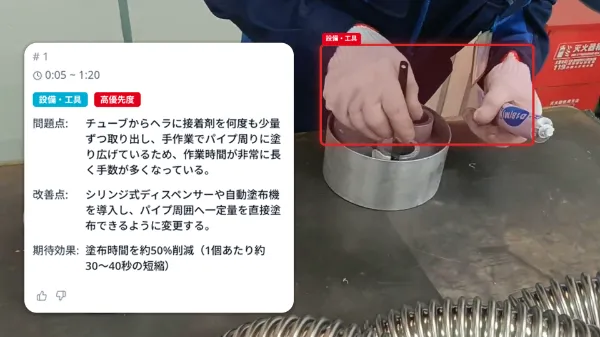
※This is an example of the Ollo Factory operation screen. The expected effects in the screen are AI suggestions, not actual measured improvement effects.
② Verify time and count before and after the changeover
Analyze time and count for individual work elements and classification by category. Confirm whether the same target work continues even after reviewing fixed positions and supply rules by reviewing search and movement.

※This is a demo screen published on Ollo's official website. It is not the result of analyzing the unit assembly described in this article.
For dirt not shown in the video and equipment condition, please confirm in combination with on-site inspection. When adopting improvement proposals, also confirm the impact on safety and quality.
Detailed features:Find improved candidates for search and organization、Verify time and count before and after the changeover。
If you want to connect 5S photo scoring to actual work improvement, please check the usage method.
Watch Ollo Factory’s Improvement Suggestions AI in Action
About the author
K.Y. | Business Development Lead & Marketing, Ollo Inc.
K.Y. leads business development and marketing at Ollo Inc., an AI startup originating from the Matsuo Laboratory at the University of Tokyo and the developer of Ollo Factory, a work analysis AI for manufacturing.
After studying engineering and design at university, K.Y. joined a major automaker and worked on new electric-vehicle development, from design through factory production, including hands-on assembly-line training. K.Y. later worked in sales and marketing at a manufacturing startup.
Today, K.Y. helps manufacturing teams use AI to improve the way they work through Ollo Factory.
Back to articles
Related articles
See how Ollo Factory can support your factory
Book a demo
• See the product in action
• Discuss your production needs
• Explore available plans
Book a demo

Request a brochure
• Customer stories
• Key features
• How to get started
