

Published:
Lean Improvement
What Is ECRS? Four Improvement Principles with Manufacturing Examples

Reducing work time can be confusing when deciding where to start reviewing; ECRS (Ekursu) serves as a guiding axis. From four perspectives—elimination, combination, exchange, and simplification—reconsider current work methods.
This article uses automobile parts unit assembly as an example to explain the meaning and order of ECRS use, concrete improvement proposals, and methods to verify effectiveness. Maintain necessary inspections and safety checks while finding methods that meet the purpose of the work.
- The four meanings of ECRS
- First, record the current situation in units of action and confirmation.
- ECRS example in unit assembly
- E: Eliminating the action of searching for tools
- If inspection results for the same unit are being transcribed from paper to another table, consider a method to reuse the results once entered for both purposes. Before consolidating records, confirm product correspondence, history tracking, required items, approval and storage conditions.
- R: Change the order of parts and preparation.
- S: Simplify operation and judgment.
- Retain the reasons for adoption and rejection of the improvement proposal.
- Verify effectiveness under the same conditions.
- Frequently asked questions.
- Must E be implemented in order?
- Can I implement the AI improvement proposal directly?
- Summary: Re-examine necessity, combination, sequence, and method.
- Manufacturing-specialized work analysis AI "Ollo Factory" that can automate the extraction of problem points and the creation of improvement proposals.
- ① Find problem points and improvement candidates.
- ② Confirm the current state and trial state in terms of time and number of repetitions.
- Watch Ollo Factory’s Improvement Suggestions AI in Action
The four meanings of ECRS
Principles | Meanings | Questions to pose in the work |
|---|---|---|
E:Eliminate | Elimination | Is it necessary in the first place? Can it be eliminated while meeting the purpose? |
C:Combine | Combination | Can it be consolidated? Can roles be restructured? |
R:Rearrange | Exchange/Replacement | Can order, location, and responsibility be changed? |
S:Simplify | Simplification | Can actions and judgments be made more easily? |
"Man-ga" for Small and Medium Enterprises Foundation: "Cost Reduction Made Clear"ECRS is introduced as a mindset for improving production processes. This article specifically explains how to apply the four perspectives to the actions and records of unit assembly.
Considering elimination, simply speeding up unnecessary work can lead to further complexity. However, decisions to eliminate inspection or approval require confirmation of the purpose and requirements. It is not necessary to implement all four proposals at once.
First, record the current situation in units of action and confirmation.
Record the current situation by separating the work flow and waste.
Basic flow:Part matching → Tool set to fixture → Fastening → Inspection confirmation → Recording → Transfer
Unexpected actions:Locations and frequency of tool search or re-set
Waiting conditions:Times and reasons for supply waiting
Ask the operator "Why is this confirmation needed?" and compare with approved procedures and quality standards. Do not judge waste solely based on appearance without knowing the purpose of the confirmation.
ECRS example in unit assembly
The following is a hypothesis for considering improvements. The results of implementation and Ollo's introduction effects are not included.
E: Eliminating the action of searching for tools
When attempting position fixation, confirm tool identification, the position reachable by the operator without strain, the return state, and the exchange procedure for abnormal situations. Do not merely tell the operator "do not search" but create an environment where searching is not required.
The method of changing tool placement can be organized as R, where the search task becomes unnecessary, as E. The same improvement may apply to multiple perspectives.
C: Consolidating information recording
If inspection results for the same unit are being transcribed from paper to another table, consider a method to reuse the results once entered for both purposes. Before consolidating records, confirm product correspondence, history tracking, required items, approval and storage conditions.
If staff copy the same unit inspection results from paper into a separate spreadsheet, see whether one entry can support both uses. Verify product traceability, required fields, approval, and retention before combining records.
While performing inspection simultaneously with another risk-associated operation, it cannot simply be combined. Check for attention dispersion and equipment conditions, and if you cannot maintain the necessary precautions for both operations, do not adopt it.
R: Change the order of parts and preparation.
There are proposals such as arranging necessary parts in the order of use, reversing the order of tightening screws. If you implement them, confirm part identification, preceding verification, equipment range of motion, and prevention of mixing and misplacement.
If "placing the next part first" causes misplacement or mixing with uninspected products, do not adopt it until you have determined identification and placement. Measure including the movement time associated with order changes.
S: Simplify operation and judgment.
Proposals such as guide for fixtures, part identification display, and photo-based procedures reduce confusion in the set. Confirm whether the display does not become too numerous to see or whether fixture changes do not affect quality conditions.
Instead of simply reducing confirmation items, ensure that necessary confirmations can be performed without hesitation. If the explanation is long, divide it into "viewing position," "normal state," and "actions when abnormal" to make it easier for the operator to judge.
If you wish to link problem scenes from video to improvement proposal consideration, you can also utilize Work Analysis AI.
Retain the reasons for adoption and rejection of the improvement proposal.
Do not omit necessary quality confirmation or safety measures.
Does the line, equipment interference, and correspondence of parts and records meet the condition?
Determine the scope of trial and the approver, and confirm that the change can be verified under the same conditions before and after.
Improvement proposal. | Principle. | Things to confirm. | Judgment examples. |
|---|---|---|---|
Eliminate tool search. | E | Reachability, identification, operation during exchange. | Try if conditions are met. |
Omit confirmation of inspection completion. | E | Do not lose necessary quality confirmation. | Rejection without grounds. |
Integrate record format. | C | Traceability, necessary items, viewing and saving. | Try after stakeholder approval. |
Reverse the order of tightening screws. | R | Part identification, supply, mixing, line. | Verification in the field. |
Add fixture guide. | S | Impact on quality, safety, and assembly. | Try after technical confirmation. |
Add to the consideration table: assigner, confirmation deadline, trial conditions, before-and-after results of improvement. If you leave reasons for rejected proposals, you can avoid repeatedly proposing the same dangerous idea later.
Verify effectiveness under the same conditions.
Align part number, work boundary, inspection range, and observation conditions before and after improvement. Confirm average time, number of searches, rework, confirmation omissions, and workload. Record the predicted time reduction separately from the actual measured time reduction.
Reflect the adopted method in the procedure sheet, layout diagram, and educational materials. Confirm whether the rules for return and supply can be continuously observed not only immediately after implementation of the improvement proposal but also thereafter.
Frequently asked questions.
Must E be implemented in order?
E→C→R→S is a consideration order that avoids spending time on fine-tuning while leaving unnecessary work. This is not a mandatory sequence for the four to be implemented. Try proposals that meet quality and safety conditions and can be verified for effectiveness.
Can I implement the AI improvement proposal directly?
The AI suggestions are for consideration. Quality conditions not shown in the video, equipment constraints, and required approvals mean the field manager must verify the conditions and attempt the trial.
Summary: Re-examine necessity, combination, sequence, and method.
Re-examine the current operation and confirmation from the perspectives of elimination, combination, exchange, and simplification.
Include the reasons for adopting or rejecting the improvement proposal, and retain the conditions for its validity.
Attempt under the same conditions to confirm time reduction and the balance of quality and safety.
Extract problem situations and create improvement proposals required for ECRS consideration can be automated by AI. While returning to the specific video scene, narrow down the proposals and select candidates for trial in the field.
Manufacturing-specialized work analysis AI "Ollo Factory" that can automate the extraction of problem points and the creation of improvement proposals.
① Find problem points and improvement candidates.
Identify problem points from the work video and present improvement proposals. Confirm the scenes of searching, switching, and returning, which can be used as material to narrow down the proposals in line with the ECRS questions.
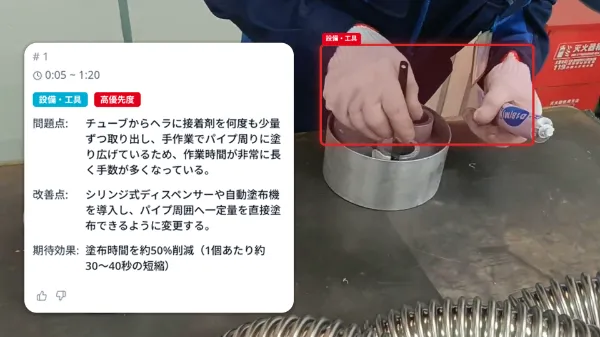
Official demo screen of Ollo Factory. This is a different task from the unit assembly example in the text.
② Confirm the current state and trial state in terms of time and number of repetitions.
Check the time and number of repetitions for element operations and classification. Attempt the adopted proposal under the same conditions, comparing whether unnecessary operations have decreased or whether necessary confirmations remain.

Official demo screen of Ollo Factory. This is a different task from the unit assembly example in the text.
The proposal is a consideration candidate. Do not implement proposals that reduce quality checks or change safety conditions without confirmation, as the field manager must judge the conditions for validity and the decision to adopt.
Watch Ollo Factory’s Improvement Suggestions AI in Action
About the author
K.Y. | Business Development Lead & Marketing, Ollo Inc.
K.Y. leads business development and marketing at Ollo Inc., an AI startup originating from the Matsuo Laboratory at the University of Tokyo and the developer of Ollo Factory, a work analysis AI for manufacturing.
After studying engineering and design at university, K.Y. joined a major automaker and worked on new electric-vehicle development, from design through factory production, including hands-on assembly-line training. K.Y. later worked in sales and marketing at a manufacturing startup.
Today, K.Y. helps manufacturing teams use AI to improve the way they work through Ollo Factory.
Back to articles
Related articles
See how Ollo Factory can support your factory
Book a demo
• See the product in action
• Discuss your production needs
• Explore available plans
Book a demo

Request a brochure
• Customer stories
• Key features
• How to get started
