

Published:
Manufacturing DX
Japan’s 2026 Digitalization and AI Adoption Subsidy for Manufacturers

When introducing AI and software to a factory, many people in charge of the project will be wondering whether they can use the Digitalization/AI Implementation Subsidy. It's important to check not only whether it's an "AI service," but also the applicant company, registered IT tools, eligible expenses, and contract timing conditions.
This article summarizes official information as of October 31, 2026, focusing on the standard application categories that are easily accessible to manufacturing companies.
To utilize subsidies, applicants must meet certain requirements, including eligibility criteria and eligible expenses, and receive approval for the grant.
- What is the Digitalization and AI Implementation Subsidy 2026?
- Subsidy amount and subsidy rate that manufacturing companies want to check under the regular framework
- We will review the target companies, tools, and expenses separately.
- 1. Business size and application requirements
- 2. Registration of IT implementation support providers and IT tools
- 3. Eligible expenses and contract/payment timing
- Application deadline and confirmation method for 2026
- The process of preparing an application for a manufacturing business
- Organize the tasks you want to improve and identify their current state.
- Check your account and required procedures.
- Apply after verifying the provider and scope of coverage.
- FAQ
- Can this be used to implement Ollo Factory?
- Summary: When applying for subsidies, be sure to check the registration, expenses, and timing together.
- Ollo Factory is a manufacturing-specific AI for work analysis that can help reduce the man-hours required for analysis and procedure manual creation.
- AI-powered video manuals support on-site work standardization.
- Comparative analysis AI visualizes the differences in work between veterans and newcomers.
- Work breakdown visualized using AI for operational analysis.
- The AI-powered improvement suggestion tool extracts potential problems.
- AI for evaluating work posture visualizes the strain on workers' postures.
- Watch Ollo Factory’s Work Analysis in Action
What is the Digitalization and AI Implementation Subsidy 2026?
The Digitalization and AI Introduction Subsidy is a program that supports small and medium-sized enterprises (SMEs) and small businesses in introducing IT tools to improve productivity. In 2026, it is advertised under the name "Digitalization and AI Introduction Subsidy."
Even with software including AI, not all products and development costs are automatically eligible. You need to select IT implementation support providers and IT tools that are registered with the program and that meet the conditions for eligible tasks and expenses.
The scope of application varies depending on the application category and type. Do not directly apply the conditions for invoices related to accounting and order processing to the factory work analysis AI.
Subsidy amount and subsidy rate that manufacturing companies want to check under the regular framework
The official announcements for the regular application category and the application guidelines for the regular application category from the 7th call for applications onward indicate the following categories:
classification | Subsidy amount | Functional Requirements |
|---|---|---|
1 or more processes | 50,000 yen or more, less than 1,500,000 yen | One or more of the specified business processes must be met. |
4 or more processes | 1.5 million yen to 4.5 million yen | The business process must meet four or more of the specified requirements. |
The subsidy rate is generally up to 1/2. However, there are categories where it can be up to 2/3 if certain minimum wage requirements are met. It's not simply applicable if you are in the manufacturing industry or if you plan to raise wages.
The number of processes is not simply a matter of counting the product's features. You cannot assume that a product has 3 processes just because it includes "video analysis," "procedure creation," and "training." We will verify the functions of the registered IT tools and their classification within the system.
We will review the target companies, tools, and expenses separately.
1. Business size and application requirements
The basic size classification for manufacturing companies in the regular category is capital of 300 million yen or less, or 300 or fewer employees. Some industries, such as rubber product manufacturing, have different classifications, so please check the application guidelines for industry names and definitions.
Meeting the size requirements alone does not determine whether an application is approved. We also review other factors such as eligibility criteria, past grant status, business plan, and salary requirements.
Starting with the 7th round of applications in 2026, changes to requirements, including an increase in the total amount of salary paid per person, have been announced. Please check the official notification of system changes and do not reuse past application materials.
2. Registration of IT implementation support providers and IT tools
Check with the vendor of the service you wish to implement to confirm their registration as a support provider and the applicable IT tool number. Even for the same service, verify that the contract details and scope of eligible expenses match your desired configuration.
Simply stating that you "use AI" or "have a track record of being selected for other subsidies" is not sufficient proof that you are eligible for this program. We will match the official IT tool search results with the verification results from the providers.
3. Eligible expenses and contract/payment timing
The standard coverage includes software purchase costs, cloud usage fees, and implementation-related expenses. Cloud usage fees are covered for up to two years, but you need to check the registration details and eligibility period.
Cameras, PCs, individual development costs, and peripheral equipment cannot be included in the budget simply by including them in the estimate along with the software. You must distinguish between eligible and ineligible items in your estimate, and please check the application guidelines for how contracts, orders, and payments will be handled before the grant decision is made.
Application deadline and confirmation method for 2026
The official final deadline notice dated October 30, 2026 , states that the application deadline is January 7, 2027, at 5:00 PM . Some newly established categories are exempt from this deadline.
Furthermore, the official project schedule indicates that the 7th application deadline for the regular category is December 1, 2026 at 5:00 PM , and the grant decision is scheduled for January 19, 2027. Please do not confuse the final deadline with the deadline for the application round you are applying for.
Deadlines for applications, grant decisions, project implementation, and reporting will be confirmed according to the application round and category. Information may change after this article is saved, so please check the latest information on the official website before applying.
The process of preparing an application for a manufacturing business
Organize the tasks you want to improve and identify their current state.
For example, if updating the unit assembly procedure manual takes a long time, measure the number of manuals created and the time spent on photography, drafting, checking, and revision. The goal shouldn't be simply to use the subsidy, but to be able to explain what improvements the implementation aims to achieve.
When estimating the effects, distinguish between actual results and assumptions. The implementation plan should include not only the AI output but also the effort required for quality control and operational management.
Check your account and required procedures.
The official application guidelines require a G-Biz ID Prime and a declaration of Security Action. Please check with your company's application manager regarding the acquisition and declaration status, and if not, prepare well in advance.
Do not share application accounts or authentication information based on personal judgment; manage them according to company rules.
Apply after verifying the provider and scope of coverage.
We will verify the support provider's requirements, target tools, expenses, and business plan. Please check the official application flow to confirm the roles of the applicant and the support provider.
Even after the grant is issued, it is necessary to carry out the project, store supporting documents, submit performance reports, and report on the effects. Since this is not a job that ends with submitting an application, we assign someone to be responsible for the post-implementation process.
Regardless of whether or not you are eligible for subsidies, you should check the product's functions and operating conditions to see how much efficiency can be achieved in work analysis and procedure manual creation.
FAQ
Can this be used to implement Ollo Factory?
Yes, Ollo Factory is a registered IT tool for the Digitalization and AI Implementation Subsidy 2026. If you meet the requirements, you may be able to utilize the subsidy when implementing it.
Summary: When applying for subsidies, be sure to check the registration, expenses, and timing together.
We will not consider a product eligible simply because it has the name "AI," but will verify the registration of the business and the IT tool.
Check the latest application guidelines for requirements regarding size, salary, functions, and expenses.
Prepare everything, including the application deadline for the chosen public offering and the post-implementation report.
Regardless of whether or not subsidies are available, clearly defining what needs to be automated on-site and which man-hours need to be reduced beforehand allows for a more concrete evaluation of potential implementations.
Ollo Factory is a manufacturing-specific AI for work analysis that can help reduce the man-hours required for analysis and procedure manual creation.
Ollo Factory uses AI to analyze work videos and support training and improvement. It offers five functions: AI-powered video manuals , AI-powered comparative analysis , AI-powered work performance analysis , AI-powered improvement suggestions , and AI-powered work posture evaluation .
AI-powered video manuals support on-site work standardization.
The AI-powered video manual system automatically divides uploaded work videos into steps and generates task names and descriptions. It can also import existing procedure manuals as reference materials and output them in your company's Excel spreadsheet format.
 Demo screen from the Ollo Factory official website.
Comparative analysis AI visualizes the differences in work between veterans and newcomers.
The comparative analysis AI allows you to compare two work videos, such as one of a model and one of a newcomer, to identify differences in the time and movements of individual tasks. You can then examine the sections where differences exist in the video and consider points for instruction and practice.
 Demo screen from the Ollo Factory official website.
Work breakdown visualized using AI for operational analysis.
The AI-powered work analysis system divides work videos into segments, classifies them, and aggregates and visualizes the time spent on each segment. Classification criteria can be set to suit the specific work environment, such as work, movement, and waiting time.
 Demo screen from the Ollo Factory official website.
The AI-powered improvement suggestion tool extracts potential problems.
The AI-powered improvement suggestion system extracts potential problems from work videos and proposes improvements. You can then review specific scenes in the video and consider improvement measures that are appropriate for your specific situation.
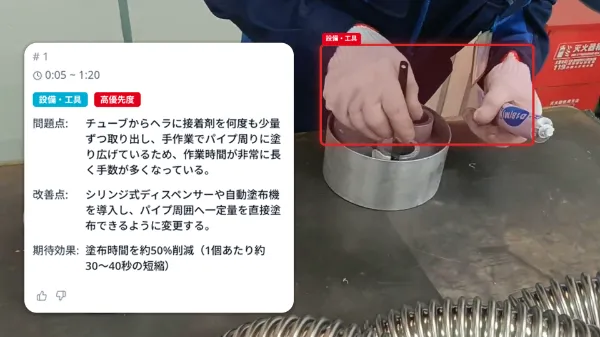 Demo screen from the Ollo Factory official website.
AI for evaluating work posture visualizes the strain on workers' postures.
The AI for evaluating work posture analyzes the skeletal structure from full-body work videos and evaluates posture using the OWAS and REBA methods. It allows for evaluation of individual task elements and review of workload over time, and the results can be revised by changing conditions such as load.
 Official demo screen from Ollo Factory.
Ollo Factory provides comprehensive on-site training and improvement services, from creating video manuals to comparing and optimizing work processes.
If you are struggling with improvement or training , please refer to Ollo Factory's materials.
Request information from Ollo Factory.
Watch Ollo Factory’s Work Analysis in Action
About the author
K.Y. | Business Development Lead & Marketing, Ollo Inc.
K.Y. leads business development and marketing at Ollo Inc., an AI startup originating from the Matsuo Laboratory at the University of Tokyo and the developer of Ollo Factory, a work analysis AI for manufacturing.
After studying engineering and design at university, K.Y. joined a major automaker and worked on new electric-vehicle development, from design through factory production, including hands-on assembly-line training. K.Y. later worked in sales and marketing at a manufacturing startup.
Today, K.Y. helps manufacturing teams use AI to improve the way they work through Ollo Factory.
Back to articles
Related articles
See how Ollo Factory can support your factory
Book a demo
• See the product in action
• Discuss your production needs
• Explore available plans
Book a demo

Request a brochure
• Customer stories
• Key features
• How to get started
